Minimal music is a movement born in 1960s America that builds entire works from the repetition of short musical figures and almost imperceptible gradual change. Proving that deep intoxication can arise without dramatic climaxes, it became the direct headwater of techno, electronica, and post-classical music. This guide walks through the four founding composers, the core compositional techniques, ten essential works, and a frustration-free listening order for newcomers.
Related reading: Introduction to Ambient Music: 10 Essential Albums from Eno to the Present
What Is Minimal Music? The Pivot Brought About by Subtraction
The definition of minimal music is, at heart, simple: pare the musical material down to the bone—short melodic cells, a handful of chords, a steady pulse—repeat it, and let it change gradually across long spans of time. Emerging in the 1960s on the American West Coast and inside the lofts and art galleries of downtown New York, it rewrote music history from outside the traditional concert hall. The term “minimal” was borrowed from contemporary visual art—Minimalism, with its repeated geometric solids and monochrome canvases—and popularized in music criticism by the composer and writer Michael Nyman.
What made this music revolutionary was how directly it defied the orthodoxy of twentieth-century “contemporary classical music.” By the mid-twentieth century, the academic avant-garde had pushed serialism and twelve-tone technique toward ever greater structural complexity and dissonance. As audiences were increasingly left behind, the minimalist composers unabashedly reclaimed tonality—the natural consonance of key centers—and a steady, driving beat. Unashamed of simplicity and unafraid of repetition, theirs was not a conservative retreat, but another avant-garde altogether: one that stepped off the treadmill of competing over complexity.
What opened their ears was music from outside the Western classical tradition: West African polyrhythmic drumming, Indonesian gamelan, and Indian classical vocal music and raga. Those musical traditions had treated repetition and sustained tone as the natural state of music for centuries. Steve Reich studied drumming in Ghana, while Terry Riley and La Monte Young apprenticed themselves to the Indian vocal master Pandit Pran Nath. Minimal music was also a movement that stepped beyond Eurocentric assumptions to rejoin the wider world of musical time.
For the listener, the crucial point is that “change” in minimal music happens in a different place than usual. In rock or pop, change happens inside the music itself—a chorus arrives, the key modulates. In minimal music, the notes barely change while the listener’s own perception transforms. The exact same phrase sounds like a different pattern five minutes later; shifting which instrument you follow changes the entire landscape. At times you even begin to hear melodies that are not written in the score—acoustic patterns that nobody is playing directly, rising out of the interference between interlocking repetitions. Repetition is not a synonym for boredom; it is an apparatus for raising the resolution of perception.

The Four Founders: Young, Riley, Reich, and Glass
The history of minimal music is traditionally told through four names: La Monte Young, Terry Riley, Steve Reich, and Philip Glass. Though grouped under a single banner, the music of each of the four sounds remarkably distinct.
La Monte Young (born 1935) is the master of sustained tone—drone. Already experimenting with extraordinarily long sustained notes in his 1958 Trio for Strings, he participated in the downtown New York Fluxus movement in the early 1960s, even publishing text-only compositions consisting of a single instruction (“Draw a straight line and follow it”). With his ensemble the Theater of Eternal Music, which included John Cale and Marian Zazeela, he built walls of amplified strings and voices lasting for hours, and later established the long-running “Dream House” sound-and-light installation in New York with Zazeela. He transformed music from something you “listen to” into something you “live inside.”
Terry Riley (born 1935) is the figure who liberated repetition. After flinging open the door to minimalism with In C in 1964, he moved into improvisational works using tape delay systems and multi-tracked electric organ, creating a kaleidoscopic solo sound world on A Rainbow in Curved Air (1969) that anticipated electronica by more than two decades. Less a strict architectural planner than a free-floating improviser riding atop repetition, Riley stands out among the four for his unhurried freedom.
Steve Reich (born 1936) is the designer of audible process. Discovering the technique of “phase shifting” through an accidental alignment of tape recorders, he declared his aesthetic in the 1968 essay “Music as a Gradual Process”: music in which the compositional process itself can be heard unfolding step by step. Following his studies of African percussion in Ghana, he forged a precise, physically propulsive ensemble style centered on mallets and percussion, reaching a pinnacle with Music for 18 Musicians (1976). Among the four founders, Reich has arguably exerted the most direct influence on contemporary popular and electronic music.
Philip Glass (born 1937) is the man of the theater. After studying in Paris with the legendary pedagogue Nadia Boulanger, Glass experienced a turning point while transcribing film music for the Indian sitar master Ravi Shankar. Returning to New York, he led his own ensemble of electric organs and winds, building propulsive music through “additive process”—expanding a short figure by adding one note at a time. Though his five-hour opera Einstein on the Beach (1976), created with director Robert Wilson, brought him international fame, he famously continued driving a New York taxicab and working as a plumber for years afterward to pay the bills—and earlier on, a young Reich and Glass even ran a moving company together to make ends meet.
Stated in a single line: Young represents sustain, Riley represents repetition and improvisation, Reich represents audible process, and Glass represents additive drive and theater. Between those four poles lies the core map of minimal music.
Even so, that map has wide margins worth noting. Just half a generation later, John Adams expanded minimalist vocabulary into dramatic orchestral writing with works like Shaker Loops, opening the territory known as post-minimalism. In Europe, the hushed devotional works of Arvo Part and Henryk Gorecki came to be grouped as “holy minimalism.” And as shown by the surging contemporary rediscovery of Julius Eastman—an extraordinary composer and performer who died in obscurity before receiving his due—the history of minimal music is still being rewritten in the present tense. The story of the four founders is a convenient doorway, not the final word.
Unpacking the Techniques: Phase Shifting, Additive Process, and Drone
The pleasure of minimal music deepens the moment you understand how it works under the hood. Three core techniques can be grasped with everyday analogies.
Phase shifting (out-of-phase repetition). Picture singing a childhood round like “Row, Row, Row Your Boat.” A conventional round layers the exact same melody at a fixed time interval. Phase shifting is a round where that interval refuses to stay fixed: two players start repeating the exact same short phrase in unison, and one player gradually speeds up by a microscopic fraction. What begins as a single unified line soon sounds like a slight echo; as the gap widens, complex interlocking patterns that neither musician is playing on their own leap out of the air, until the two parts come full circle back into unison. Reich discovered this phenomenon by chance in 1965 while playing two tape loops of a street preacher’s voice on recorders running at slightly different speeds (It’s Gonna Rain), and in 1967’s Piano Phase he translated it from tape machines to live human pianists. Turning the drift itself into music is the beating heart of minimalist technique.
Additive process (composition by addition). This is the method of lengthening a repeating figure by adding notes to it step by step. Repeat “do–re” several times, then expand it to “do–re–mi,” then to “do–re–mi–fa,” or reverse the direction by subtracting notes one by one. When you listen to Philip Glass and feel as though you are spinning in the same place while the scenery around you has mysteriously transformed, this “proliferating vortex” is the mechanism at work. The arithmetic is elementary, yet the physical sensation is exhilarating, sweeping the listener up in its momentum.
Drone (sustained tone). At the opposite pole from rhythmic change lies the technique of listening to a sound that does not move. Hold a single tone or chord continuously over a long span of time, and your ear begins to separate out the overtones—the higher harmonic frequencies hidden inside a single fundamental note. To make the resonance of those overtones as pure as possible, La Monte Young went so far as to retune the piano from standard equal temperament to just intonation, eliminating the acoustic beating between intervals. Inside a sound where “nothing is happening,” an entire universe of hidden tones is actually living; drone is the microscope built to reveal it.
What all three techniques share is what Reich called a “gradual process”—the commitment to laying the mechanism bare in the open air once set in motion. Rather than dictating every dramatic turn by hand, the composer designs a process and watches it unfold. And when the listener makes the same switch—from waiting for the next plot twist to observing the microscopic shifts happening right now—the music comes alive all at once.
In truth, these techniques are less eccentric inventions than reunions with the oldest strata of musical history: phasing is an extreme cousin of the medieval canon, additive process is a stripped-down form of variation, and drone has been the foundation of church organs and Indian tanpuras for centuries. What made minimalism new was its purity in building an entire work out of that single principle alone. Moreover, repetition carries a direct physiological effect: bathe in a steady pulse long enough, and your breathing and bodily rhythm align with the cycle of the music, inducing a light, waking trance. Minimalism organized into concert music the bodily truth that dance music had known by instinct all along.
10 Essential Works: Experiencing the Joy of Repetition
Here are ten landmark works arranged in approximate chronological order through which you can experience the history of minimal music firsthand. Because several of these pieces span an hour or more, there is no need to treat finishing them in one sitting as an obligation—start by immersing yourself for just ten minutes at a time.
Terry Riley, “In C” (1964)
Often called the Declaration of Independence of minimal music. The entire score fits on a single page consisting of 53 short melodic modules; each performer repeats a module as many times as they see fit before advancing to the next. Scored for any number and combination of instruments, it changes shape at every performance, yet because everyone shares the tonal center of C and a steady eighth-note pulse (reportedly suggested by Steve Reich during rehearsals for the premiere), a luminous, rolling cloud of sound rises every time. Start with the classic 1968 Columbia recording.

YThe Pop Group
Steve Reich, “It’s Gonna Rain” (1965)
Born from the accidental drift of two tape recorders playing a recording of a Pentecostal street preacher in a San Francisco plaza, this piece is the ground zero of phase shifting. As the short spoken fragment “It’s gonna rain!” repeats and slips out of alignment, the human voice gradually ceases to function as language and turns into a swirling vortex of rhythm and pitch—all while retaining the raw urgency of an apocalyptic sermon. It is worth remembering that minimal music began not with an orchestra, but with a recorded human voice in a public square.

Early WorksSteve Reich
Terry Riley, “A Rainbow in Curved Air” (1969)
An electronic kaleidoscope created entirely solo by Riley overdubbing electric organ, harpsichord, dumbek, and tambourine. Shimmering arpeggios rotate across multiple layers until the listener’s sense of clock time dissolves. Its impact on rock was immediate: The Who paid tribute to Riley in the title of “Baba O’Riley,” and the British progressive rock band Curved Air took their name directly from this album. Much of later synthesizer music, ambient, and electronica branched out from this single trunk.
YThe Pop Group
Steve Reich, “Drumming” (1971)
An expansive percussion tapestry lasting roughly an hour and a half, written after Reich returned from studying Ewe drumming in Ghana. Tuned bongos, marimbas, and glockenspiels repeat a single rhythmic pattern while female voices, whistling, and piccolo step in to sing and trace the “resulting patterns”—phantom melodies that nobody is playing directly, leaping out of the acoustic interference of phased drums. No other work organizes the hallmark minimalist thrill of hearing unwritten melodies inside repetition on such a grand scale. It stands as the summation of Reich’s early period.

Drummingスティーヴ・ライヒ
Philip Glass, “Music in Twelve Parts” (1971-74)
An encyclopedia of additive process spanning more than three hours in complete performance, composed by Glass for his own ensemble. Electric organs, winds, and voices sprint forward as a single engine, ratcheting up the rotational speed of the vortex each time a new note is added to the pattern. There is no need to hear all twelve parts at once; drop into any single part and the visceral exhilaration of proliferating music comes through immediately. Glass’s signature blend of solemnity and buoyant lightness reached full maturity here.

Music in Twelve Partsフィリップ・グラス
Steve Reich, “Music for 18 Musicians” (1976)
Widely regarded not merely as a landmark of minimalism, but as one of the summits of late-twentieth-century music as a whole. Over a brisk pulse kept by marimbas and pianos, a cycle of eleven chords breathes slowly in and out while clarinets and female voices sustain each harmony for the exact length of a human breath—marrying watchmaker precision with living bodily warmth. Released in 1978 on the jazz label ECM, it reached an audience far wider than contemporary classical records ever dreamed of. Asked to name a single first album for minimal music, most listeners would point right here.

Music for 18 MusiciansSteve Reich
Philip Glass, “Einstein on the Beach” (1976)
A monumental five-hour opera performed without intermission, created in collaboration with stage director Robert Wilson. Dispensing with conventional plot, its libretto consists entirely of sung numbers and solfege syllables (“do–re–mi”), and audience members were explicitly invited to walk in and out of the hall freely during the performance. Staging the twentieth-century myth of Albert Einstein not as a biography, but as an architectural experience of time, it premiered at the Avignon Festival in 1976 and packed the Metropolitan Opera in New York. For an accessible entry point, start with the recurring interlude movements known as the “Knee Plays.”

Einstein on the Beachフィリップ・グラス
Philip Glass, “Glassworks” (1982)
A six-piece collection consciously designed by Glass as an accessible portable introduction to his musical world. The quiet solo piano triplet figure that opens the first track, “Opening,” remains among the most widely loved few minutes of music he ever wrote. Even listeners intimidated by five-hour operas can step in here without hesitation. Intriguingly, the original cassette release included a special mix tailored for the newly popularized Sony Walkman—anticipating “contemporary classical music heard while walking through the city” decades ahead of its time.

Glassworksフィリップ・グラス
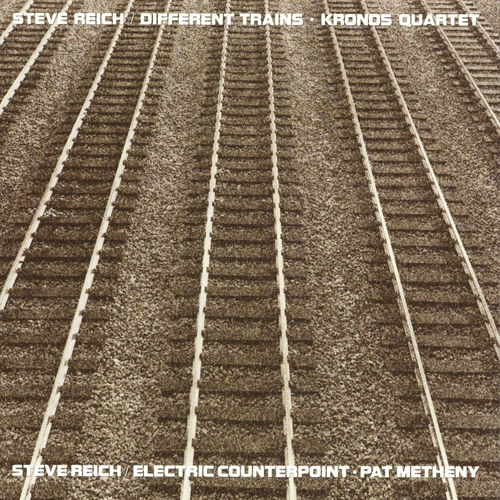
Steve Reich, “Different Trains” (1988)
Scored for string quartet and pre-recorded tape and premiered by the Kronos Quartet, this work juxtaposes Reich’s childhood memories of riding cross-country trains between New York and Los Angeles during World War II with the contemporaneous trains carrying European Jews to Nazi concentration camps, built from recorded speech fragments of Holocaust survivors and American train porters. By transcribing the exact pitch and cadence of each speaker’s voice directly into the string melodies, Reich dissolves the line between historical testimony and musical form. Honored with the Grammy Award for Best Contemporary Composition, it stands as a late-period masterpiece showing how minimalist repetition could carry the weight of history.
Different TrainsSteve Reich
La Monte Young, “The Well-Tuned Piano” (1964-)
A sprawling solo work exceeding five hours in performance, played by Young himself on a grand piano tuned in pure just intonation. Conceived in 1964 and expanding across decades, its landmark 1981 performance was released as a five-disc recording in 1987. Inside billowing clouds of resonant overtones, quiet melodic fragments surface briefly and dissolve back into the air. Admittedly not a record for absolute beginners, it is the ultimate destination for experiencing what Young meant by “living inside a sound”—music of suspended time on the far side of repetition.
YThe Pop Group
Influence on Pop and Techno: How Repetition Conquered the World
The history of minimal music’s influence reads like a secret history of modern popular music. The first point of contact took place in 1960s New York: John Cale, a member of La Monte Young’s Theater of Eternal Music, carried the concept of the sustained drone directly into the Velvet Underground, where it rang out in the abrasive viola of tracks like “Venus in Furs.” Minimalism was already standing backstage at the exact moment rock met the avant-garde. And in 1971, The Who placed a Terry Riley-inspired repeating synthesizer figure at the center of stadium rock on “Baba O’Riley.”
In Germany, the generation of bands grouped as Krautrock arrived almost simultaneously at the ecstasy of repetition. Can co-founder Irmin Schmidt often spoke of how encountering the work of Riley and Young in 1960s New York proved transformative, while the unvarying 4/4 “motorik” beat of Neu! and the mechanical pulse of Kraftwerk from Autobahn (1974) onward forged a minimalism of highways and industrial cities. When young Black producers in Detroit discovered Kraftwerk and gave birth to techno—which in turn spawned the subgenre of “minimal techno,” anchored by landmarks like Robert Hood’s Minimal Nation (1994)—the circle of naming came full round, uniting the repetition of the loft concert and the repetition of the dancefloor.
Still, it helps to distinguish direct lineage from convergent evolution. The sequencer pulse that Giorgio Moroder and Donna Summer unleashed on “I Feel Love” (1977) and the loop-based architecture of Chicago house were less direct children of academic minimalism than parallel discoveries of the same truth: make music with machines, and you arrive naturally at repetition. Even so, by the 1990s the two streams had merged openly, citing one another across genres. Widen the lens to include the interlocking guitar patterns of post-rock and the loop structures of video-game soundtracks, and minimalist repetition is no longer the property of a single movement, but the shared grammar of modern music.
Sampling and remix culture embraced it just as warmly. British ambient-house pioneers The Orb famously built their 1990 classic “Little Fluffy Clouds” around a sample of Steve Reich’s Electric Counterpoint, and the official 1999 tribute album Reich Remixed handed Reich’s masters to electronic producers including Coldcut and Ken Ishii. On the rock side, Philip Glass answered David Bowie and Brian Eno’s Berlin Trilogy by composing orchestral symphonies based on “Low” and “Heroes”, while the mutual admiration between Radiohead and Steve Reich led Jonny Greenwood to perform Electric Counterpoint and Reich to compose Radio Rewrite (2012) on themes from two Radiohead songs.
Japan was part of this story from early on. Long before becoming a household name for his Studio Ghibli film scores, Joe Hisaishi began his career as a minimalist composer, participating in the 1981 percussion ensemble project MKWAJU alongside percussionist Midori Takada, whose 1983 solo masterpiece Through the Looking Glass later ignited a global revival of Japanese environmental music. Add the post-classical works of Max Richter and Nils Frahm, the lineage of minimalist film scoring since Glass’s Koyaanisqatsi (1982), and everyday television commercials, and the reach of minimal music covers virtually the entire modern acoustic landscape. In truth, there is no one left today who has never heard minimal music—only people who did not yet know its name.
A 7-Step Listening Path for Newcomers: How Not to Bounce Off
To close, here is a concrete seven-step listening path. Because newcomers to minimal music are more likely to stumble over “how to hold their attention” than over which piece to pick first, this sequence moves from immediate sensual pleasure down into the experimental core.
Step 1 is Steve Reich’s Music for 18 Musicians: its sheer sonic warmth dissolves any wariness toward minimalism within the first ten minutes. Step 2 is Terry Riley’s In C: once you know the simple rule of 53 modules and free progression, comparing different recordings becomes a game in itself. Step 3 is Philip Glass’s Glassworks for a concise dose of melodic magnetism, followed by Step 4, Riley’s A Rainbow in Curved Air, for pure electronic euphoria. By the end of Step 4, you will have experienced all the main varieties of minimalist pleasure.
Step 5 steps into the laboratory: listen to Reich’s It’s Gonna Rain and Piano Phase to witness the discovery of phase shifting in the raw. They may sound austere at first, but re-read the technique section above and follow the exact moment the two parts slip out of lockstep. Step 6 tackles long-form architecture with Drumming, Music in Twelve Parts, or Einstein on the Beach—not as an endurance test, but left playing in your room while you let your ears wander out and back in. Step 7, the deepest chamber, is La Monte Young’s The Well-Tuned Piano and the world of pure drone; if you ever visit New York, you can also step physically inside the permanent Dream House installation in Tribeca.
Keep three simple listening tips in mind. First, do not wait for a dramatic climax; leaning forward in anticipation of a chorus works against the grain of this music, whereas suddenly realizing “wait, everything has changed” is the right posture. Second, vary your volume and posture by occasion: listening closely at higher volume to trace interlocking patterns and playing the same piece quietly in the background yield two completely different experiences. Third, catch a live performance whenever you can, because the physical air pressure of sustained repetition in a hall cannot be fully captured on tape—and since In C can be played by anyone with basic instrumental skills, joining an ensemble yourself is always an option.
Using your daily commute or walk is another practical approach. Although many minimalist works are long, the flip side is that they hold together even when heard in segments; splitting the ninety minutes of Drumming across three twenty-five-minute train rides works remarkably well. Rather than tossing a single short track into a shuffled playlist, living inside one long work over the course of a week matches the time sense of minimal music far better. Here, going around in circles is not a detour—the circle itself is the destination.
Conclusion: Sounds That Can Only Be Heard Inside Repetition
Let us summarize the main points of this guide:
- Minimal music is an American movement born in the 1960s built on pared-down material, repetition, and gradual change—an “alternative avant-garde” that stepped away from academic complexity.
- Its four founding figures are La Monte Young (sustain/drone), Terry Riley (repetition and improvisation), Steve Reich (audible process), and Philip Glass (additive drive and theater).
- Its three signature techniques—phase shifting, additive process, and drone—all lay their workings openly before the listener’s ear.
- Its influence runs from the Velvet Underground and Kraftwerk through techno, electronica, post-classical music, and film scores, forming the bedrock of our contemporary soundscape.
- Start with Music for 18 Musicians, moving gradually from immediate pleasure to audible mechanism and long-form depth.
What minimal music teaches us is that even inside stretches of time where nothing seems to be changing, countless events unfold the moment we lend our ears closely. Unwritten melodies rise out of the interference between repeating patterns, and the exact same phrase sounds transformed ten minutes later. Those phantom melodies are not printed anywhere in the score—they are, in the truest sense, “the sound that isn’t there.” Before dismissing repetition as monotony, try standing on the inside of a loop just once. From the very first eighth-note pulse of In C, the door is always open.
Further reading:
To me, the real thrill of repetitive music lies less in the notes themselves than in observing how your own ears change while listening. A phrase that should be identical sounds like an entirely different piece of music ten minutes later. Hearing transformations that are written nowhere in the score may be the most tangible example of what this site calls “the sound that isn’t there.”