Officially Listed Albums
20 albums
Recording & Release Span
50+ years
Primary Project Names
3 projects
If you are setting out to explore the vast body of recordings by Michael Rother—known worldwide as the guitarist and melodic architect behind both NEU! and Harmonia—the single best starting point is his 1977 solo debut, Flammende Herzen. Over an unshakeable, steady eight-beat pulse played by CAN drummer Jaki Liebezeit, two sustained electric guitar lines recorded and mixed by Conny Plank entwine across all five instrumental tracks. Both the forward-driving repetition of NEU! and the warm, multi-layered harmonic sensibility of Harmonia crystallize in their purest form on this single LP. From that anchor, stepping back to the 1972 self-titled debut NEU! and Harmonia’s 1975 second album Deluxe, then moving forward through 1978’s Sterntaler, 1979’s Katzenmusik, and finally his 2022 collaborative album As Long As The Light provides a six-stage listening pathway that never loses its bearings.
The scope of this guide covers all 20 official full-length albums across three primary project names whose recording dates, studio locations, and tracklists can be verified directly against Rother’s official discography (michaelrother.de) and the catalog archives of his rights-holding label, Grönland Records. That total comprises 11 solo and duo-billed albums, 4 albums as NEU!, and 5 albums associated with Harmonia. We exclude his brief several-month tenure as a live member of Kraftwerk in 1971—which yielded no official studio album releases—as well as isolated guest session appearances on other artists’ records.
Why Listening by Project Name or Chronological Release Date Leaves Newcomers Stranded
The first structural obstacle facing any listener approaching Michael Rother’s catalog is that his core creative work is split across three separate artist billings—NEU!, Harmonia, and his solo name—so searching a single artist profile on a streaming service never shows the whole picture. Even more treacherous is the fact that within each individual billing, the instrumentation, personnel, and acoustic architecture shift abruptly from one record to the next. Between December 1971, when the debut NEU! album was cut during four nocturnal sessions at Windrose Studios in Hamburg, and January 21, 2022, when Rother released his collaborative album As Long As The Light with Vittoria Maccabruni, full fifty years of studio releases elapsed. Once you include his ongoing live concerts—such as his August 15, 2026 appearance at the Neue Nationalgalerie in Berlin—his active performance and recording career spans fifty-five years.
Suppose a listener decides to tackle the four NEU! albums strictly in order of release, moving from the 1972 debut NEU! directly into 1973’s NEU! 2. Only halfway through the second album, on Side B, the music suddenly fractures into something unrecognizable as a normal studio performance. The entire second half of NEU! 2—running from track 5, “Neuschnee 78,” through track 11, “Super”—was assembled as an emergency measure after the duo exhausted their recording budget mid-session and their record company refused to advance additional studio funds. Desperate to fill the second side of the LP contract, Klaus Dinger and Michael Rother took their already-recorded single tracks “Neuschnee” and “Super,” placed the vinyl seven-inch discs on a turntable at 78 rpm and 16 rpm, and ran them through a cassette recorder with intentional tape manipulation and phasing. While Side B of NEU! 2 stands today as a legendary proto-remix document in twentieth-century avant-garde history, a newcomer following Rother’s guitar and harmonic design hits an abrupt cul-de-sac on only their second record.
A similar trap awaits anyone who attempts to listen exclusively to Rother’s eleven solo albums in chronological order starting in 1977. His first four solo records—Flammende Herzen (1977), Sterntaler (1978), Katzenmusik (1979), and Fernwärme (1982)—all feature CAN’s Jaki Liebezeit playing live acoustic drums in the studio. Starting with his fifth solo album, 1983’s Lust, however, Liebezeit departs the lineup completely. Rother retreated into his home studio in the rural village of Forst and transitioned to a completely solo workflow built around programming the Fairlight Music Computer and digital sequencers by himself. The subtle micro-timing fluctuations, rim resonances, and tom overtones of Liebezeit’s acoustic kit vanish overnight, replaced by the crisp, quantized digital sequencing characteristic of mid-1980s electronic production. If you play Lust or 1985’s Süssherz und Tiefenschärfe expecting a direct continuation of the first four solo albums, the sonic texture changes so drastically that it hardly sounds like the same ensemble.
Compounding the confusion is a massive historical gap between recording dates and commercial release dates on several essential works. Tracks and Traces, the celebrated collaboration where Brian Eno joined Harmonia in rural Germany, was recorded in September 1976 at Forst—yet the tapes remained unreleased for twenty-one years until November 4, 1997. Likewise, NEU! ’86, recorded when Rother and Klaus Dinger reunited between October 1985 and April 1986, was abandoned amid personal and artistic disagreements and sat in the vaults for nearly a quarter-century before Rother reconstructed and mixed the master tapes between July and December 2009 for its eventual 2010 release. Because modern streaming platforms sort discographies by publication year or reissue date rather than session date, playing a streaming catalog from top to bottom scrambles 1976 magnetic tape recordings alongside 2000s ProTools reconstructions. That chronological distortion is precisely why a listener needs an intentional route that cuts across all three project names and starts where Rother’s musical architecture is clearest.
The 6-Stage Listening Path to the Core of All 20 Albums
1
《Flammende Herzen》 1977 · 1st Solo Album (Grönland)
Why Start Here
Because the two foundational pillars of Rother’s musical language—the forward-moving harmonic stasis he co-invented in NEU! and the warm, overlapping melodic counterpoint he cultivated in Harmonia—fuse here in their most distilled form over Jaki Liebezeit’s unwavering eight-beat drum groove. Although all five tracks are purely instrumental, the opening seven minutes of the title piece “Flammende Herzen” lay out every element of Rother’s artistic signature without a single wasted note.
2
《NEU!》 1972 · 1st NEU! Album (Grönland)
Why This Position
Once your ear has absorbed the melodic warmth and sustained guitar arcs of Flammende Herzen, stepping back to the December 1971 Hamburg sessions reveals just how radically Rother stripped away blues clichés at the very beginning of his career. Against Klaus Dinger’s raw, driving drum pulse, you can clearly hear how Rother used subtraction, single-note bass drones, and bowed or sustained guitar harmonics to turn the ten-minute opener “Hallogallo” into a landmark of post-blues rock.
3
《Deluxe》 1975 · 2nd Harmonia Album (Grönland)
Why This Position
Stepping away from the high-wire duo tension of NEU!, this third stage shows how Rother’s gift for bright chordal themes blossomed inside a three-way partnership with Cluster’s Hans-Joachim Roedelius and Dieter Moebius. Recorded when Conny Plank brought his mobile recording rig to Harmonia’s rural studio in Forst—with Guru Guru drummer Mani Neumeier adding live percussion on key tracks—this LP became the direct womb of Rother’s solo career the following year.
4
《Sterntaler》 1978 · 2nd Solo Album (Grönland)
Why This Position
Created by the exact same core trio of Rother, drummer Jaki Liebezeit, and co-producer Conny Plank as Stage 1’s Flammende Herzen, this second solo outing expands the timbral palette with Hawaiian slide guitar, vibraphone, and string synthesizer textures. You can trace how the sharp edges of Rother’s lead guitar dissolve into a wider, radiant stereo panorama across the seamless flow from opener “Sonnenrad” through the title track “Sterntaler.”
5
《Katzenmusik》 1979 · 3rd Solo Album (Grönland)
Why This Position
Every track on this record is titled simply by a serial number from “KM 1” through “KM 12,” representing the structuralist peak of Rother’s catalog: a single concise harmonic and melodic motif varied across twelve distinct tempos, rhythmic settings, and sonic densities. With four albums of context already in your ears, watching one deceptively simple theme rotate through twelve different angles over forty minutes becomes an absorbing structural experience.
6
《As Long As The Light》 2022 · Michael Rother & Vittoria Maccabruni (Grönland)
Why This Position
Released exactly fifty years after the 1972 debut of NEU!, this eight-track collaborative album demonstrates how Rother’s unmistakable 1970s sustained guitar tone breathes inside contemporary electronic production and vocal textures. Rather than treating his work as a museum artifact from West Germany’s past, ending the core sequence here confirms that repetition and harmonic suspension remain a living, present-tense language fifty years on.
Anatomy of Each Stage: Listening Highlights and Recording Architecture
Stage 1: Flammende Herzen (1977) — The Benchmark Where Two-Layer Sustained Guitars Meet Jaki Liebezeit’s Eight-Beat
Recorded between June and September 1976 at Conny’s Studio in Wolperath near Cologne, Flammende Herzen marks Michael Rother’s debut as a solo recording artist. Born in Hamburg in 1950, Rother grew up playing the music of The Beatles and Jimi Hendrix during his teenage years, yet as the 1970s began he made a conscious, decisive break from Anglo-American blues scales and rock conventions. As the official liner notes to Grönland Records’ Solo box set document, Rother stopped listening to other pop and rock records almost entirely during this period so that no external clichés would seep into his hands. Eliminating pentatonic string bends, twelve-bar turnarounds, and aggressive riffing, he built a self-contained guitar vocabulary from the ground up.
Nowhere is that vocabulary heard with greater clarity than on the opening title track “Flammende Herzen” and the second piece, “Zyklodrom.” Across these sessions, Rother overdubbed electric guitar, electric piano, the Dehgitarre (a custom-modified guitar equipped with a pitch-bending mechanism), bass, synthesizer, organ, and electronic percussion entirely by himself. He entrusted the acoustic drum kit alone to CAN’s Jaki Liebezeit. Liebezeit’s drumming stands in fascinating contrast to Klaus Dinger’s headlong, aggressive attack in NEU!. Where Dinger leaned forward into the beat as if pushing a locomotive to the brink of derailment, Liebezeit locked snare and hi-hat strokes into a machine-precise grid that never wavers by a millisecond, while tuning his toms to generate a warm, circular low-mid resonance.
Above that unshakeable rhythmic lattice, Rother’s distorted electric guitar never strums a conventional rhythm chord. Instead, he stacks two long, singing single-note guitar lines in parallel thirds or sixths, letting them rise and fall in gentle, breathing arcs over static or two-chord harmonic beds. On track 3, “Karussell,” and track 4, “Feuerland,” Rother avoids dramatic key changes or conventional verse-chorus explosions altogether. Instead, he sustains seven-minute spans of music by subtly adding and subtracting layers of organ pad and electric piano arpeggio underneath the twin guitars. Right through to the tranquil closing decay of track 5, “Zeni,” these five pieces explain why Rother’s work is not austere academic avant-gardism, but rather pop music purified to its most essential melodic glow.

Flammende HerzenMichael Rother
Stage 2: NEU! (1972) — The Ten Minutes of “Hallogallo” Born from Four Nocturnal Studio Nights
Once the radiant warmth of Flammende Herzen is firmly lodged in your ear, stepping back to the 1972 debut album NEU! reveals how the exact same principle of repetition operates at a completely different temperature and level of physical tension. The album was recorded over four consecutive nights in December 1971 at Windrose Studios in Hamburg—booked at night because studio rates were cheaper—and mixed at Ralf Arnie’s Star-Music Studio. The band consisted solely of Klaus Dinger and Michael Rother, both fresh off their departure from an early lineup of Kraftwerk, joined at the console by co-producer and engineer Conrad (Conny) Plank.
Across the entire ten minutes and seven seconds of the opening track “Hallogallo,” the underlying chord never changes once. Over Dinger’s famous steady eight-beat drum pattern—later dubbed the “Motorik” beat by music journalists, though Rother himself preferred the term “Lange Gerade” (long straight road)—Rother anchors the harmony with a single repeated bass note while weaving gossamer layers of wah-pedaled, phased, and backward-taped guitar in and out of the mix. The guitar here does not sing a traditional foreground melody; instead, it functions like sunlight shifting angles through the window of a high-speed train, continuously modulating overtones and spatial depth while the rhythmic engine stays locked at constant velocity.
Crucially, NEU! is far more than a one-track album built around “Hallogallo.” Following the metallic, industrial clatter of track 2, “Sonderangebot,” the third track “Weissensee” slows the tempo to a meditative crawl where Rother’s mournful slide guitar glides across a still, mirror-like surface. That serene, suspended lyricism on “Weissensee” and track 4, “Im Glück,” represents Rother’s personal fingerprint inside NEU!—the very seed that would later blossom in Harmonia and on Flammende Herzen. Set against the ferocious, jackhammer noise of track 5, “Negativland,” and the abrasive closer “Lieber Honig,” the six tracks of NEU! capture two contrasting musical temperaments pulling in opposite directions at the moment of maximum creative friction. To see how this December 1971 breakthrough fits into the wider timeline of West German experimental rock, read it alongside 10 Essential Krautrock Albums Traced Through Official Label Chronologies.

NEU!NEU!
Stage 3: Harmonia, Deluxe (1975) — Communal Life in Forst and Conny Plank’s Mobile Recording Rig
In 1973, after completing the turbulent sessions for NEU! 2, Rother traveled to the tiny rural village of Forst along the Weser River to visit Hans-Joachim Roedelius and Dieter Moebius, the duo behind Cluster, hoping to recruit them to add fuller accompaniment for live NEU! performances. Instead, the first musical jam between the three men proved so revelatory that Rother moved to Forst and formed Harmonia with them. Their January 1974 debut LP, Musik von Harmonia (eight tracks), was self-recorded by the trio in Forst using rudimentary rhythm boxes, organ loops, and guitar repetitions. On August 20, 1975, however, the release of their second album Deluxe (six tracks) transformed the trio’s sonic architecture completely.
In June 1975, Conny Plank drove his mobile multi-track recording equipment out to Harmonia Studio in Forst to capture the sessions on location, before mixing the tapes at Conny’s Studio in July 1975. The structural leap from Musik von Harmonia to Deluxe is immediately audible. Not only do Rother’s radiant major-key chord progressions and soaring guitar themes step firmly into the foreground, but Guru Guru drummer Mani Neumeier joins as a guest musician, injecting propulsive live acoustic drumming into the opening title track “Deluxe (Immer wieder)” and the third track, “Monza (Rauf und runter).”
On “Deluxe (Immer wieder),” Rother’s sustained lead guitar and the trio’s multi-tracked vocal harmonies cut right through the center of Roedelius’s shimmering keyboard ostinatos and Moebius’s swirling synthesizer modulations. Meanwhile, tracks like “Walky-Talky,” “Gollum,” and the closing “Kekse” unfold like pastoral chamber-ambient pieces where electronic oscillations and acoustic piano blend seamlessly. On November 14, 2025, Grönland Records celebrated the album’s fiftieth anniversary with a limited orange-vinyl LP edition—a testament to Deluxe‘s standing as the happiest intersection of band ensemble playing and electronic pastoralism in Rother’s entire career.

DeluxeHarmonia
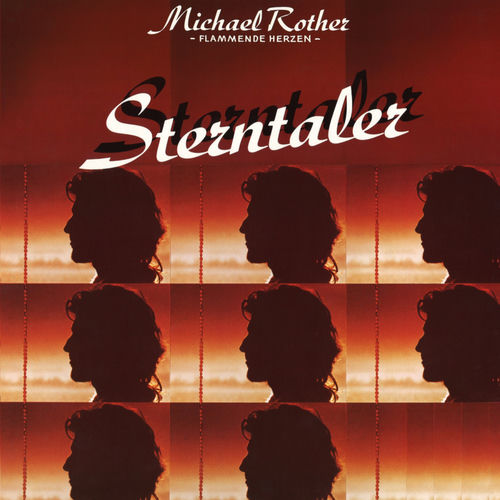
Stage 4: Sterntaler (1978) — Expanding the Color Spectrum with Hawaiian Guitar and Vibraphone
Buoyed by the critical and commercial success of Flammende Herzen in Germany, Rother recorded his second solo album, Sterntaler, between September and November 1977 at Forst and at Conny’s Studio, releasing it in 1978. While the core production team remained unchanged—co-produced by Rother and Conny Plank with Jaki Liebezeit on drums—a close inspection of the instrument credits on Rother’s official discography reveals a significant expansion in timbre. Alongside electric guitar, piano, bass, and synthesizer, Rother added vibraphone, Hawaiian lap-steel guitar, and lush string arrangements to the studio palette.
From the opening bars of track 1, “Sonnenrad” (“Sun Wheel”), the midrange feels noticeably richer and more enveloping than on his debut. The liquid portamento of the Hawaiian guitar creates an open, sun-drenched horizon that flows effortlessly into track 2, “Blauer Regen” (“Blue Rain”), where crystalline piano and vibraphone mallets sparkle beneath long, arching guitar sustain. Track 3, “Stromlinien,” glides without friction into the gentle waltz-like lilt of the fourth and title piece, “Sterntaler.”
The album’s second half reaches its peak on track 5, “Fontana Di Luna,” and the closing sixth piece, “Orchestrion.” Here Liebezeit moves beyond straight eight-beat timekeeping, weaving crisp, march-like snare rolls and syncopated accents underneath Rother’s multi-tracked guitar choir, which functions like a miniature mechanical orchestra (“Orchestrion”) trading contrapuntal lines. If Flammende Herzen is the pure, stoic diamond of Rother’s repetition aesthetic, Sterntaler is its warmer sister work—pouring orchestral color and resonant overtones into the same structural vessel.
SterntalerMichael Rother
Stage 5: Katzenmusik (1979) — A Structural Experiment Varying One Motif Across “KM 1” to “KM 12”
Recorded between March and July 1979 at Forst and Conny’s Studio, Rother’s third solo album Katzenmusik possesses the boldest conceptual architecture in his entire twenty-album catalog. None of its twelve tracks carry descriptive titles; on Grönland Records’ official product listings, they appear simply as “KM 1” through “KM 12” (originally printed on the LP sleeve as “Katzenmusik 1” through “Katzenmusik 12”).
In contrast to the expanded acoustic and orchestral instrumentation of Sterntaler, the album credits are stripped back to the bone: “Michael Rother: Guitar, Electronics / Jaki Liebezeit: Drums / Produced by Rother & Plank.” Running through the entire album is a single, disarmingly simple melodic and chordal motif introduced in the brief opening miniature “KM 1.” As the numbered tracks progress through “KM 2,” “KM 3,” and beyond, that identical thematic cell is subjected to twelve distinct structural variations—First carried by a brisk electronic rhythm box pulse, then stretched across Liebezeit’s thunderous tom-tom patterns and soaring distorted guitar leads, and later dissolved into hushed, reverberant synthesizer nocturnes.
Where American minimalists such as Steve Reich transformed repetition through gradual phase-shifting and additive rhythmic processes, Rother constructed Katzenmusik‘s forty-minute suite by transplanting a single melodic organism into twelve contrasting acoustic environments and rhythmic gears. Readers interested in how post-Reichian minimalism branched into rock and electronic composition can compare this German methodology with the composers profiled in 5 Composers and Essential Works That Carried Minimalism Forward After Steve Reich.

KatzenmusikMichael Rother
Stage 6: As Long As The Light (2022) — A Present-Tense Collaboration Arriving Fifty Years After NEU!
We anchor the sixth and final stage of our core route in As Long As The Light, Rother’s collaborative album with Italian-born, Berlin-based electronic musician and vocalist Vittoria Maccabruni, released by Grönland Records on January 21, 2022. Arriving exactly fifty years after the 1972 release of the debut NEU! LP, its eight tracks (1. Edgy Smiles / 2. Exp 1 / 3. You Look At Me / 4. Curfewed / 5. See Trough / 6. Forget This / 7. Codrive / 8. Me Happy (Slow Burner)) prove that Rother is not a nostalgic heritage act replaying past glories, but an active, curious contemporary sound designer.
On the opening track “Edgy Smiles” and track 3, “You Look At Me,” Rother’s signature liquid, long-sustain guitar lines hover and curl around Maccabruni’s cool electronic production and understated vocals. On instrumental-leaning cuts such as track 2, “Exp 1,” and track 7, “Codrive,” minimal electronic pulses and hypnotic guitar repetition are reframed within the sub-bass architecture of post-club electronic music, offering a transparent digital spatiality distinct from the warm magnetic tape saturation of 1970s Conny’s Studio recordings.
If a listener stops their chronological clock in 1979 after hearing only Rother’s classic early LPs, it is all too easy to treat his music as a museum specimen frozen in 1970s West Germany. Hearing this 2022 collaboration right after Katzenmusik—before doubling back to explore his 1980s through 2000s catalog—lets you perceive fifty years of changing studio tools as one continuous artistic arc.

As Long As The LightMichael Rother & Vittoria Maccabruni
Five Eras of Studios and Lineups Traced Through Official Label Chronologies
Within the five-era chronology above, three pivotal transitional albums recorded between 1975 and 1981 deserve special attention: NEU! ’75, Harmonia & Eno ’76 — Tracks and Traces, and Rother’s fourth solo album Fernwärme. Understanding how these three records connect to our six-stage core pathway unlocks the entire architecture of his career.
Recorded at Conny’s Studio between December 1974 and January 1975, the six-track album NEU! ’75 saw Rother reunite with Klaus Dinger after spending a year and a half living and recording with Harmonia in Forst—yet the resulting LP is structured unlike either of the first two NEU! records. Side A (track 1 “Isi,” track 2 “Seeland,” and track 3 “Leb’ wohl”) follows Rother’s serene, melodic conception: Dinger plays acoustic drums while Rother layers electric guitar, piano, and lush synthesizer strings into radiant instrumental pieces. On Side B (track 4 “Hero,” track 5 “E-Musik,” and track 6 “After Eight”), however, the roles split dramatically: Dinger steps up to play slashing electric guitar and deliver furious, snarling lead vocals while his brother Thomas Dinger and Hans Lampe pound out a twin-drum assault simultaneously. Across the two sides of a single vinyl disc, the duo’s musical paths diverged cleanly into two distinct futures. Out of Side A’s “Isi” and “Seeland” grew Rother’s 1977 solo debut Flammende Herzen; out of Side B’s “Hero” sprang Dinger’s group La Düsseldorf and a direct lineage into late-1970s punk and post-punk. Just how deeply that split reverberated through British and European underground rock can be traced from the opposite angle in An Introduction to Post-Punk Organized Through Chronologies and 10 Essential Albums.

NEU! ’75NEU!
Recorded in 1981 at Rother’s own studio in Forst (then named “Flammende Herzen Studio” after his breakthrough solo debut) and released on March 23, 1982, his fourth solo album Fernwärme (seven tracks: 1. Silberstreif / 2. Elfenbein / 3. Erlkönig / 4. Fortuna / 5. Klangkörper / 6. Hohe Luft / 7. Fernwärme) serves as the closing capstone of his classic early solo quartet. On this record, Conny Plank stepped away from the co-producer chair, leaving Rother to handle both engineering and production entirely on his own for the first time—yet Jaki Liebezeit remained behind the drum kit. On opener “Silberstreif” and track 3, “Erlkönig,” the weight of electronic sequencers increases markedly compared to the previous three LPs, creating a striking thermal contrast (the German title Fernwärme translates literally as “district heating”) where cool, pulsing synthesizer grids interlock with Liebezeit’s warm acoustic snare and toms. Once you have finished the first three solo albums in our core pathway, Fernwärme is the single most rewarding next stop.

FernwärmeMichael Rother
Tracing the Intersections Through Four Key Collaborators and Producers
Because the rhythmic center of gravity and spatial depth of Rother’s recordings shift decisively depending on who shared the studio room with him, mapping his catalog through his four primary creative partnerships offers an illuminating second lens.
The single most important architectural partner in Rother’s 1970s work was producer and recording engineer Conny Plank. From December 1971’s NEU! right through 1979’s Katzenmusik, Plank’s name appears on every major studio milestone Rother recorded in that decade (with the sole exception of the self-recorded Musik von Harmonia). It was Plank’s mixing mastery—smoothing the pick attack off Rother’s sustained guitars while separating drum room microphones and synthesizer panning into a three-dimensional stage—that kept repetitive structures from ever flattening into mechanical loops.
Equally decisive was the rhythmic anchor provided by CAN drummer Jaki Liebezeit. Whereas Klaus Dinger’s drumming in NEU! was a linear, forward-leaning sprint, Liebezeit brought a low-slung, circular, polyrhythmic eight-beat when he joined Rother for the June 1976 Flammende Herzen sessions. Listeners who already know CAN’s Tago Mago or Future Days will immediately recognize how the hypnotic percussive discipline that held CAN’s collective improvisations together takes on a completely new, song-like radiance inside Rother’s pre-composed harmonic structures.
Just as historically resonant is Rother’s September 1976 encounter with Brian Eno. Having released his landmark album Another Green World the previous year, Eno publicly hailed Harmonia as “the world’s most important rock group” and traveled personally to Harmonia Studio in Forst in September 1976, living and recording communally with Roedelius, Moebius, and Rother for eleven days. Those sessions are preserved on Tracks and Traces (first issued on November 4, 1997, and expanded in 2009 with three additional archival pieces into a twelve-track definitive edition). Across tracks such as “Welcome,” “Vamos Companeros,” the Eno-sung “Luneburg Heath,” and the meditative “Trace,” Rother pulls his guitar back even further into the ambient mist, creating the exact sonic bridge that would lead directly into Eno’s 1977 work on David Bowie’s Low and his own Ambient series. For the immediate precursor to Eno’s arrival in Forst, see A 1975 Record of How 9 of 14 Tracks Turned Instrumental on Brian Eno’s Another Green World.

Tracks and TracesHarmonia & Eno ’76
Date Discrepancies and Box Set Architectures Revealed by Comparing Official Sources
When you place the discography pages on Rother’s official website (michaelrother.de) side by side with the product documentation published by his label Grönland Records, two fascinating details emerge that never show up on streaming service metadata: a half-century pattern in how Rother named his studio, and a concrete date discrepancy between the two primary sources.
First, both official sources confirm a charming historical habit: throughout the 1980s and 1990s, Rother repeatedly renamed his home studio in Forst after the title of whichever solo album had just succeeded before it. Tracing the studio credits chronologically on michaelrother.de shows that 1981’s Fernwärme was recorded at “Flammende Herzen Studio, Forst”; 1983’s Lust was recorded at “Sterntaler Studio, Forst”; 1985’s Süssherz und Tiefenschärfe (recorded November 1984 to February 1985) was cut at “Katzenmusik Studio, Forst”; 1987’s Traumreisen (recorded January to July 1987) is credited to “Fernwärme Studio, Forst”; 1996’s Esperanza (recorded 1995 to January 1996) lists “Random Studio, Forst”; and 2004’s Remember [The Great Adventure] (recorded 1997 to 2004) lists “Esperanza Studio, Forst.” Rother was not moving from town to town renting different facilities; he has continuously worked out of the same rural base in Forst that he first inhabited with Harmonia in 1973, christening the room anew with each technological generation.
Second, Grönland’s catalog pages clarify how his modern remastered box sets organize the solo canon. On June 21, 2019, the label reissued his first four solo albums (Flammende Herzen, Sterntaler, Katzenmusik, and Fernwärme) in digital remasters struck from the original analog master tapes, simultaneously compiling them into the retrospective box set Solo (a 5-CD or 6-LP set accompanied by a 36-page booklet designed by Walter Schönauer, adding his film soundtracks Houston from 2013 and Die Räuber from 2015 plus Live & Remixes). On September 4, 2020, Grönland followed up with the 7-CD box set Solo II, uniting his five studio albums from 1983 through 2004 (Lust, Süssherz und Tiefenschärfe, Traumreisen, Esperanza, and Remember (The Great Adventure)) with a Bonustracks disc and his brand-new nine-track solo album Dreaming. Together, Solo and Solo II house all ten solo studio albums released between 1977 and 2020.
At the same time, cross-checking the two primary archives exposes one explicit date discrepancy regarding Harmonia’s archival concert album Live 1974 (released by Grönland on September 18, 2007, capturing a five-track concert at Penny Station in Griessem, Germany: 1. Schaumburg / 2. Veteranissimo / 3. Arabesque / 4. Holta-Polta / 5. Über Ottenstein). Grönland Records’ official product page states that the performance was “Recorded live in concert on March 23rd 1974,” whereas Rother’s official discography page on michaelrother.de states “Recorded live in concert on 23rd May 1974.” Because neither primary document provides an external concert handbill to break the tie between March 23 and May 23, 1974, we record both dates here without forcing an unverified guess.
Three Albums You Should Never Pick as Your First Listen—and the Structural Reasons Why
《NEU! 2》1973 (2nd NEU! Album)
Recorded in January and February 1973 at Windrose Studios, Side A’s eleven-minute opener “Für Immer” is an undeniable masterpiece of motorik repetition worthy of the debut LP. However, Side B (“Neuschnee 78,” “Super 16,” “Cassetto,” “Super 78,” and related fragments) consists of turntable speed-manipulation experiments created when recording funds ran dry mid-session. Newcomers expecting full-band guitar and drum interplay across both sides are invariably thrown off balance when half the album dissolves into warped 78 rpm and 16 rpm single edits; always save this record until after you have heard both NEU! (1972) and NEU! ’75.
《Lust》1983 (5th Solo Album)
Recorded in 1983 at Sterntaler Studio in Forst, this six-track album (“Palmengarten,” “Primadonna,” “Dynamotron,” and others) was written, performed, engineered, and produced by Rother completely alone. Here Jaki Liebezeit’s live acoustic drumming disappears entirely, replaced by the Fairlight CMI digital sampling synthesizer and programmed electronic beats. Listeners looking for the warm, organic guitar-and-drum breathing of his 1970s records will lose their compass if they start here; approach Lust only after completing the 1977–1982 four-album solo cycle.
《NEU! ’86》Recorded 1985–1986 / Released 2010 (4th NEU! Album)
Begun by Dinger and Rother between October 1985 and April 1986 at Grundfunk Studio in Düsseldorf and Sterntaler Studio in Forst before collapsing amid personal friction, this work was reconstructed by Rother from the master tapes between July and December 2009 and issued as a thirteen-track archival release in 2010. Blending mid-1980s Fairlight textures, spoken-word and collage fragments, and callbacks to 1970s motifs, it is a fascinating historical postscript that misrepresents the core sound of NEU! if heard first.
Where to Branch Out After Completing the 6-Stage Core Path
Once you have traveled through the six-stage core pathway presented in this guide (Flammende Herzen → NEU! → Harmonia’s Deluxe → Sterntaler → Katzenmusik → As Long As The Light) alongside the three key bridges (NEU! ’75, Fernwärme, and Tracks and Traces), you will hold the entire structural blueprint of how Michael Rother built a fifty-year musical language around non-blues repetition and sustained harmonic glow.
If you want to branch outward to his West German contemporaries who pioneered parallel forms of repetition—such as CAN’s Spoon Records catalog or Cluster’s Bureau B reissues—our companion guide 10 Essential Krautrock Albums Traced Through Official Label Chronologies maps out the exact connections by original release year and track sequence. Conversely, if you want to explore Rother’s later digital-era solo work from the 1990s onward, proceed in order through 1996’s Esperanza (17 tracks), 2004’s Remember [The Great Adventure] (9 tracks), and his September 4, 2020 solo album Dreaming (9 tracks) to hear how he preserved his signature singing guitar sustain inside drumless and computer-edited environments. Regardless of which decade you drop the needle into, that unmistakable guitar tone—carrying the listener across vast distances without ever forcing a dramatic cadential resolution—has remained true to its course since December 1971 in Hamburg.
Primary Sources & Official References
- Michael Rother Official Website — Discography (Complete Solo / NEU! / Harmonia Recording Dates & Credits) (Verified November 1, 2026)
- Michael Rother Official Website — Home & Live News (Harmonia “Deluxe” 50th Anniversary Edition & 2025–2026 Tour Archive) (Verified November 1, 2026)
- Grönland Records — Michael Rother “Solo” CD Box Official Product Documentation & Liner Notes (Verified November 1, 2026)
- Grönland Records — Michael Rother “Flammende Herzen” Product Archive / “Sterntaler” Product Archive / “Katzenmusik” Product Archive / “Fernwärme” Product Archive (Verified November 1, 2026)
- Grönland Records — Michael Rother “Solo II” Box Product Archive / “As Long As The Light” Product Archive / NEU! “NEU! ’75” Product Archive (Verified November 1, 2026)
Note: Because neither Rother’s official discography nor Grönland Records’ individual catalog pages list exact day-and-month publication dates for his three mid-1980s solo albums (Lust, Süssherz und Tiefenschärfe, and Traumreisen), this article cites only their verified recording months and release years.