Post-classical is an umbrella term for music that plays the instruments and compositional forms of classical music with a post-electronica sense of studio recording. At its core lies not a multitude of notes, but the deliberate architecture of quietude, shaped into an international movement during the 2000s by composers such as Max Richter and Nils Frahm. This guide walks through the definition and lineage of the genre, ten essential albums, and how to live with this music during work, reading, and sleep.
Related reading: Introduction to the ECM Label: The Aesthetics of the Most Beautiful Sound Next to Silence and 10 Essential Albums
What Is Post-Classical Music? Definition and Contours
Let us start by sorting out the terminology. “Post-classical” is not an academic term, and several neighboring labels—modern classical, indie classical, neoclassical—coexist to describe roughly the same territory. What they share is a structural shift: composer-performers trained in classical music and its vocabulary operate not within the institutional framework of the symphony hall, but through the circuits of indie music—small independent labels, rock clubs, home studios, and streaming platforms. The recording, rather than the printed score, is the primary body of the work, and microphone distance and tape texture become integral parts of composition itself. That alone sets it decisively apart from traditional twentieth-century contemporary classical music.
In terms of sound, three traits stand out: first, intimate chamber instrumentation centered on piano and strings; second, a seamless blend with electronic sound design; and third, a thoroughgoing devotion to pianissimo—playing softly. Melodies are simple and repetitive, harmonies remain tonal, and there is almost none of the listening friction associated with the academic avant-garde. Because of that accessibility, the genre is sometimes dismissed as “mere background music,” yet its finest works share a clear critical question: how do you construct quietude in sound? Refusing to write loud notes is not the same thing as writing silence, and the critical core of the genre resides in that difference.
On the institutional side, independent record labels played a decisive role. Launched in 2001 as an imprint of the UK label FatCat, 130701 provided the first home for this music by introducing Max Richter, Hauschka, and Dustin O’Halloran, while London’s Erased Tapes, founded in 2007, defined the genre’s aesthetic with Olafur Arnalds and Nils Frahm. In Iceland, Valgeir Sigurdsson’s Bedroom Community built its own collaborative ecosystem, and before long even the venerable Deutsche Grammophon was partnering with Richter and his peers. The present-day coordinates of post-classical music lie right where the authority of classical tradition meets the agility of indie culture.
Nor is this wave limited to Europe and North America. In Japan, Akira Kosemura’s Schole label and artists like haruka nakamura have cultivated closely related music since the late 2000s, preceded by the towering figure of Ryuichi Sakamoto. In their sensitivity to hushed piano timbres and environmental sound, Japanese musicians and listeners have never been mere bystanders on the periphery of this movement, but full participants in its creation.
Whether the prefix “post-” implies “what comes after classical music” is not something we need to overthink. In practice, this is less a campaign to carry the future of the classical canon on its shoulders than music answering the present-day need of listeners seeking quietude and negative space. Viewed from the conservatory, it may look like a borderland; viewed from the history of quiet music, it is an unmistakable mainstream.
Lineage: From Satie to Part and Gorecki
Trace the family tree of post-classical music back to its roots, and the first figure standing there is Erik Satie. His 1888 Gymnopedies, in which a melody free of operatic gravity drifts over a simple repeating accompaniment, became the prototype for virtually all “quiet piano” music that followed. Then in 1920, Satie proposed “Furniture Music”—music meant not to be actively listened to, declaring that music need not demand concentration and may simply inhabit daily life. Half a century later, Brian Eno formalized this idea as ambient music, and contemporary post-classical composers inherited it directly. That Gavin Bryars’s quiet experimental work The Sinking of the Titanic was released in 1975 as the inaugural title on Eno’s Obscure label is a telling proof of the bloodline shared by both genres. Along the same stream, Harold Budd—who collaborated repeatedly with Eno—built an early bridge between ambient music and chamber music with piano tones submerged in a mist of sustain pedal. The felt piano of post-classical music is a direct descendant of Budd’s reverberation.
A second headwater is the minimal music of the 1960s onward. The techniques of repetition established by Steve Reich and Philip Glass popularized the sense of assembling music as a sustained state rather than a dramatic harmonic narrative. It is thanks to this legacy that so many post-classical pieces are unafraid of “not developing.” And the third—and spiritually perhaps the largest—headwater is the “holy minimalism” of Eastern Europe. In 1976, the Estonian composer Arvo Part established his bell-inspired tintinnabuli style with Fur Alina, going on in works like Spiegel im Spiegel (1978) to create devotional music of extreme economy. Frequently cited as one of the most performed living composers in the world, Part—together with the hushed recording aesthetic of the ECM label that championed his work—serves as the compass for the generation that followed.
One more event deserves to be called a watershed. Written in 1976 by the Polish composer Henryk Gorecki, Symphony No. 3 (“Symphony of Sorrowful Songs”) became an unprecedented crossover phenomenon when its 1992 recording featuring soprano Dawn Upshaw and conductor David Zinman climbed the British pop charts and went on to sell more than a million copies worldwide. The equation “contemporary classical music = forbidding complexity” collapsed overnight, proving in the language of the marketplace that a vast public hungered for music of deep grief and consolation. When post-classical music emerged in the 2000s, the soil to receive it had already been tilled.
Post-classical music, in other words, was no sudden mutation. Satie’s “unheard music,” minimalist repetition, the devotional stillness of Part and Gorecki, and post-Eno studio sensibility: these tributaries converged in the new riverbed of the internet and independent labels to form the genre we hear today.
Max Richter and the Philosophy of “Sleep”
The composer who stood at this confluence with the clearest self-awareness is Max Richter. Born in Germany and raised in the United Kingdom, Richter completed formal classical training before presenting the blueprint for the genre on Memoryhouse (2002) and The Blue Notebooks (2004). Recorded in the shadow of the Iraq War’s outbreak, the latter weaves Tilda Swinton’s spoken readings together with piano, strings, and electronics into a book-like work of protest and solace. Its centerpiece, “On the Nature of Daylight,” was later featured in films such as Arrival, becoming one of the most widely heard string compositions of the twenty-first century. The album’s poise—consolation in the shape of grief—remains a benchmark for the entire genre.
Richter’s importance goes beyond writing moving melodies. On 2012’s Recomposed by Max Richter: Vivaldi – The Four Seasons, he boldly rewrote Vivaldi’s warhorse, reconstructing a pillar of the classical canon through the sensibilities of the recording studio age. Including the fact that Deutsche Grammophon backed the project, it was a work that opened a doorway through the institutional wall between classical tradition and post-classical music.
Then, in 2015, Richter released Sleep: an eight-and-a-half-hour composition written for a sleeping audience. Developed in consultation with neuroscientist David Eagleman to align with the cycles of nocturnal sleep, the piece was staged at unprecedented overnight concerts where the audience lay in rows of beds rather than seats, while its complete radio broadcast was reported as one of the longest live broadcasts of a single work in history. A one-hour companion edition, from Sleep, has since become a staple of nighttime playlists worldwide.
The philosophical core of Sleep lies in taking seriously the proposition that “music continues to work even while no one is consciously listening to it.” If Satie’s Furniture Music was a wry avant-garde provocation, Richter’s Sleep is an explicit objection to an accelerating information economy. Richter himself has repeatedly described the work as a lullaby for a frenetic world and a piece of music defending the endangered human right to rest. Listening while falling asleep is not a defeat for music; it is the act of building an eight-and-a-half-hour sanctuary outside the economy that competes for our waking attention. Sleep proved that the quietude of post-classical music can be not merely a style, but a philosophy.
By designing the duration of a work around the biological time of the listener’s life, Sleep also anticipated later developments in generative music and sleep-timer streaming habits. The unit of a musical work need not be the three-minute single or the forty-minute album; it can be an entire night. A decade after its release, the full reach of that proposal is still unfolding.
Makers of Quietude: Four Portraits
Alongside Richter, four composers helped draw the contours of the genre. That their starting points and methods differ so widely is proof of the movement’s richness.
Olafur Arnalds
Born in Iceland in 1986, Olafur Arnalds began his musical life in an unexpected place: as a drummer in hardcore and metal bands. Since releasing Eulogy for Evolution (2007) with the newly founded Erased Tapes, he has become one of the defining faces of the genre through his blend of piano, string quartet, and delicate electronics. He won a BAFTA Award for his score to the British drama Broadchurch and explores dancefloor minimalism as half of the techno duo Kiasmos. On re:member (2018), he introduced “Stratus,” custom software that triggers two self-playing pianos in real-time response to his keyboard performance, opening a fresh dialogue between algorithms and hushed acoustic sound. Keeping human warmth alive between cool machinery and tender harmony is his signature virtue.
Nils Frahm
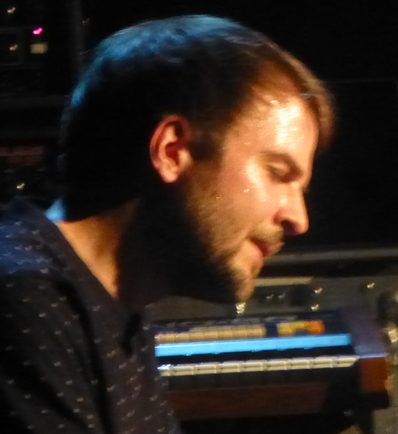
Born in Hamburg in 1982 and based in Berlin, Nils Frahm is equal parts pianist and recording engineer. Recorded late at night in his apartment with felt wedged between the hammers and strings so as not to wake his neighbors—and miked at extreme close range—his 2011 album Felt defined the genre’s aesthetic of quietness and intimate mechanical noise. His catalog ranges from the wit of Screws (composed for nine fingers while recovering from a broken thumb) to the cathedral-scale ambition of All Melody (2018), recorded inside a bespoke studio he built at Berlin’s historic Funkhaus broadcast complex. Known for his obsessive love of instruments and vintage recording gear, he also founded “Piano Day,” celebrated worldwide on the 88th day of the year. On stage, moving freely between banks of synthesizers and acoustic pianos, he shows how quietude can become a celebration.
Johann Johannsson
Born in Reykjavik in 1969 and passing away suddenly in Berlin in 2018, the Icelandic composer Johann Johannsson brought an unmistakable sense of elegy to the blending of strings and electronics from his solo debut Englaborn (2002) onward. Inspired by his father’s career as an IBM maintenance engineer in Iceland, he created conceptual works that mourn the ruins of technology, including IBM 1401, A User’s Manual (2006), built from the electromagnetic emissions of a retiring mainframe computer, and Fordlandia (2008), themed around Henry Ford’s failed rubber-plantation city in the Amazon. In cinema, he won a Golden Globe for The Theory of Everything and rewrote the vocabulary of modern film scoring with Sicario and Arrival, a legacy carried forward by collaborators such as Academy Award winner Hildur Gudnadottir. Johannsson carried the deep, solemn shadow of post-classical music.
Hauschka
Performing as Hauschka, the Dusseldorf-based German composer and pianist Volker Bertelmann revived the twentieth-century technique of the “prepared piano”—wedging felt, tape, ping-pong balls, and bottle caps between the piano strings to transform its timbre—building a world on Ferndorf (2008) and Salon des Amateurs (2011) where playfulness, dance rhythms, and nostalgia coexist. Active in cross-genre collaborations such as Silfra with violinist Hilary Hahn, he earned an Academy Award nomination for his score to Lion and won the Oscar for Best Original Score in 2023 for All Quiet on the Western Front. He embodies both the playful experimentalism of post-classical music and its highest professional craft.
The Aesthetics of Piano and Pianissimo: Noise Is Not the Enemy
Nothing defines the sound of post-classical music more clearly than how it treats the piano. Rather than the brilliant forte of a concert grand in a recital hall, it favors cotton-soft tones dampened with felt and the woody intimacy of an upright piano. Microphones are placed right beside the strings and hammers, capturing the creak of the sustain pedal, the groan of the piano bench, the player’s breathing, and even the room’s ventilation. What traditional classical engineering worked tirelessly to edit out as “unwanted noise,” this genre welcomes in as part of the music. That shift marks a transformation in aesthetics: not a spotless document of an idealized performance, but a document of the entire span of time inside the room where the performance took place. What the listener receives is not just the notes, but the intimacy of a room late at night.
The emblem of this aesthetic is the felt piano. What began as a practical mute for keeping the volume down—Frahm’s Felt literally grew out of consideration for his neighbors—has become a standard timbre of its own, sampled in commercial software instruments around the world. Going a step further, Frahm partnered with piano maker David Klavins to build the “Una Corda,” a custom instrument strung with only one string per key instead of three. Rather than merely playing a loud instrument softly, they engineered softness into the physical structure of the instrument itself—a testament to the seriousness of the genre’s vision.
The aesthetic of pianissimo also transforms the listener’s side of the equation. When volume is low and change unfolds slowly, the ear naturally dives into microscopic detail: decaying overtones, the puff of air as the damper pedal lifts, the hush between one phrase and the next. Layers that remain inaudible inside loud music disclose themselves only inside quietude. From the side of recording art, no genre comes closer to the experience this blog calls “hearing the sound that isn’t there.”
There is, of course, a pitfall. The surface trappings of felt piano and mechanical key clicks are easy to imitate, and streaming platforms are flooded with generic tracks that copy the effect. Putting felt on hammers does not automatically summon meaningful silence. The real test for distinguishing great work lies in the design of the rests—whether genuine musical tension is sustained during the moments when no note is played. Every album recommended below passes that test.
Quietude Carried by Film and Television
The widest channel through which post-classical music reached a global audience was the screen: Johannsson’s scores for The Theory of Everything and Arrival, Hauschka and Dustin O’Halloran’s collaboration on Lion, Arnalds’s music for Broadchurch, and Max Richter’s ubiquitous presence across international cinema and television dramas. Quiet repetitions of piano and strings trace the outline of emotion without crowding out dialogue or over-explaining the scene. The virtues demanded by modern visual storytelling and the aesthetics of post-classical music aligned almost completely. In television series like The Leftovers, scored by Richter, a recurring piano theme returning across seasons functioned as a memory device for the viewer’s own emotions.
Nothing symbolized this synergy more powerfully than director Denis Villeneuve’s use of Richter’s “On the Nature of Daylight” in the film Arrival. Placed at both the opening and the close of the story, the same piece of music carried the film’s central philosophical theme—the circularity of time—on its back. Rarely does a pre-existing composition fulfill such a structural role in cinema, demonstrating that post-classical music can participate directly in a film’s thought rather than serving as mere accompaniment.
This partnership with visual media reshaped the economics of the genre as well. Viewers who discover a composer through a soundtrack trace their way back to the studio albums, while massive “peaceful piano” playlists on streaming platforms catch and amplify the flow. Playlists with millions of followers mean that quiet instrumental music has become one of the most widely heard musical forms of the twenty-first century. At the same time, critics rightly point out that playlist-optimized, interchangeable tracks risk lowering the artistic waterline of the genre. Film and playlists are powerful carriers, but pausing where they drop you off to listen to a composer’s thought at the scale of a complete album remains the best courtesy we can pay this music.
10 Essential Albums: A Gateway to the Quiet Intersection
Below are ten essential albums arranged in approximate chronological order, tracing a continuous line from two foundational precursors through the modern canon. Every one of them reveals its truest colors at low volume late at night.
Arvo Part, “Tabula Rasa” (1984)
The compass of “holy minimalism” and the historic inaugural release of ECM’s classical imprint, the New Series. From the prayer-like dialogue of violin and piano on “Fratres” to a title work that feels built entirely from the decaying resonance of bells, the album captures moments where a scarcity of notes translates directly into spiritual density. It is the origin point to which post-classical composers return again and again, and the backbone of the entire genre—flawless right down to the stillness of its recording.

Tabula RasaArvo Pärt
Henryk Gorecki, “Symphony No. 3: Symphony of Sorrowful Songs” (1992 recording)
The landmark of late-twentieth-century music of consolation that became an unprecedented international bestseller for a contemporary classical score. Slow layers of strings ebb and flow like a tide while a solo soprano prayer rises above them. Completely free of academic obscurity yet never light, the very fact that music embracing deep grief was sought out by so many listeners stands as a vital testimony from the eve of the post-classical era. A record for nights when words fail.

YThe Pop Group
Max Richter, “The Blue Notebooks” (2004)
The album that deserves to be called the architectural blueprint of the genre. Piano, strings, electronics, and Tilda Swinton’s spoken readings are woven together as a quiet protest against an age of war. The aching beauty of “On the Nature of Daylight” needs no introduction, yet the true body of the work lies in the lingering afterglow of hearing the album straight through from start to finish, like closing a book. It was the first work to prove that post-classical is not merely “pretty music,” but music that thinks.

The Blue Notebooksマックス・リヒター
Johann Johannsson, “IBM 1401, A User’s Manual” (2006)
A requiem for technology scored for string orchestra and the electromagnetic tones of a retiring mainframe computer. Using recordings of the machine his father once maintained as raw material, Johannsson portrays the farewell between human beings and a machine with unsentimental grace. The mechanical tones flickering faintly beneath sustained strings serve as an epitaph for “sounds that were always there, though no one was listening.” For conceptual coherence and emotional depth, it stands among the finest records in the genre.

IBM 1401 A User's ManualJohann Johannsson
Hauschka, “Ferndorf” (2008)
Named after the German village where the composer spent his childhood, this is music of nostalgia performed on prepared piano. With wedges placed between its strings, the piano rings at times like a gamelan and at times like a wooden toy, cavorting with cello and violin to sketch memories of vanished landscapes. Despite its experimental technique, the aftertaste is unfailingly warm—a delightful neighbor in the genre reminding us that quietude need not be monochrome.

Ferndorfハウシュカ
A Winged Victory for the Sullen, “A Winged Victory for the Sullen” (2011)
A collaboration between pianist Dustin O’Halloran and drone master Adam Wiltzie (of Stars of the Lid). Hushed piano, strings, and long harmonic sustains melt into one another, building a cathedral-wide stillness right on the border between ambient and post-classical music. With tempos slower than a resting pulse, you can physically feel the flow of time decelerate in the room—irreplaceable both as music on the threshold of sleep and as a companion for late-night reflection.

A Winged Victory for the SullenA Winged Victory for the Sullen
Nils Frahm, “Felt” (2011)
Recorded at close range on a piano dampened with felt, this is the textbook of the pianissimo aesthetic. Hammer strikes, pedal creaks, and the room’s ambient hush are braided directly into the composition, inviting the listener into a Berlin apartment past midnight. The duet between melodic beauty and “recorded silence” is the true subject of the record. Listen on headphones at low volume, and the very meaning of the word “noise” changes—a historic release that set the timbral standard for the entire genre.

Feltニルス・フラーム
Ryuichi Sakamoto, “async” (2017)
Released after his recovery from serious illness, this landmark inscribed Japan’s presence onto the global map of post-classical and ambient music. Out-of-tune piano, environmental recordings of rain and city streets, and synthesizer sustains are placed side by side out of synchronization (“async”), allowing sound to exist simply as sound prior to polished musical order. Also presented as an exhibition of “installation music,” it questioned the boundary between listening and simply being in a space. Updating the Japanese lineage of ma stretching back to Toru Takemitsu with contemporary recording philosophy, it is an essential recommendation for readers of this site.
YThe Pop Group
Olafur Arnalds, “re:member” (2018)
An ambitious work in which human performance converses with piano responses generated by Arnalds’s custom “Stratus” software. Contrary to the cold impression the word “algorithm” might suggest, the music feels as fresh as air after rain, with string arrangements opening up the horizon each time they enter. Welcoming technology as a co-creator rather than an enemy of quietude points toward one future for the genre—a deeply human album crafted with cutting-edge tools by a former hardcore drummer.
re memberOlafur Arnalds
Hania Rani, “Esja” (2019)
The solo piano debut by a leading pianist of Poland’s new generation, released on Manchester’s Gondwana Records. With pared-down repetition and close, breathing microphone work, the album vividly refreshes the post-Felt piano aesthetic. Named after places and landscapes, its pieces are short as prose poems and move at a walking pace—serving both as an ideal doorway into the genre and as proof that this music has already been passed into the hands of the next generation.
Esjaハニア・ラニ
Pairing with Work, Sleep, and Reading: The Etiquette of Background Listening
Post-classical music is widely used as a companion for focused work, sleep, and reading. Some view this utility as a degradation of the genre, but I disagree. From Satie’s Furniture Music to Richter’s Sleep, this lineage has embraced “music placed inside daily life” head-on from the very beginning. Concert-hall concentration is not the only form of respect you can pay to music—though living with it does call for a few small points of etiquette.
When pairing the music with work, the keys are gradual change and the absence of lyrics. Pieces with dramatic climaxes or sharp emotional swings pull attention away from the task at hand; records that move with a steady pulse, such as re:member or All Melody, work best. The trick is to turn the volume down to the threshold where you hear it only if you consciously check for it—submerging the music into the background of attention so that only the rhythm of thought remains. Conversely, weighty conceptual works like Johannsson’s darker albums are ill-suited to background work; those are records meant for setting your pen down and listening.
Sleep is where this genre truly stands unrivaled. Sustain-centered works like Sleep or A Winged Victory for the Sullen gently untangle the loops of thought as you drift off. In practice, leaving an album playing from start to finish at whisper-quiet volume is less likely to wake you with a sudden jolt of silence than setting a short sleep timer. Part’s hushed compositions also suit the night, though their inner tension was never designed as a sleep aid—it is worth keeping prayer and lullaby distinct.
When pairing with reading, matching the density of the book to the density of the music works wonders. Pair fiction with solo piano records like Felt or Esja that stay out of the story’s way, and pair slower, reflective reading like poetry or criticism with contemplative ensembles like The Blue Notebooks. And to repeat one final request: regardless of how you use an album in daily life, once you find a record you love, set aside time just once to listen to it while doing nothing else. Inside music you had been brushing past in the background, you will discover countless microscopic details—the creak of a pedal, the fading tail of a chord, the sounds that were always there though you had not yet heard them. After that discovery, even your background listening will grow richer.
Conclusion: Chamber Music for the Age of Recording
Post-classical music is chamber music for the age of recording, born at the quiet intersection of classical tradition and electronica. Satie’s “unheard music,” minimalist repetition, the devotional stillness of Part and Gorecki, and post-Eno studio sensibility converged here, given a blueprint by Max Richter and enriched in distinct dialects by Olafur Arnalds, Nils Frahm, Johann Johannsson, and Hauschka. The muffle of felt, the breath of tape, the creak of a pedal: what this genre loves is not a flawless fortissimo, but the fading tail of a dying note and the quiet tension of time left unplayed. The ten essential albums above are simply doorways for testing that architecture of quietude for yourself. In the background of work or at the bottom of sleep, this music will gladly do its job—yet when you occasionally stop everything and lean into the interior of a hushed note, post-classical music reveals its finest face, letting you hear the sound that isn’t there just beyond the sound that is.
Further reading:
The soft strike of a piano hammer, the creak of a pedal, the quiet breath of magnetic tape: to me, post-classical is the music of the smallest audible sounds sitting just one step before “the sound that isn’t there.” It is a wonderful companion for work or sleep, but if you can, try sitting down with it at least once while doing nothing else at all.