Recorded on Sunday, June 25, 1961, at the basement jazz club the Village Vanguard in New York, Sunday at the Village Vanguard (Riverside RLP 9392) stands as a watershed in modern jazz history, where Bill Evans, Scott LaFaro, and Paul Motian dismantled the conventional hierarchy of soloist and accompanists to perfect a three-way conversational improvisation (interplay) among equals.
Selected from five sets across two afternoon matinees and three evening performances, the recordings from that day were released as this album and its sister record, Waltz for Debby (Riverside RLP 9399). The three-dimensional spatial architecture woven from decaying piano tones, bass counter-melodies, the brush strokes of the drums, and the faint ambient sounds of the audience went far beyond a simple live document to define the very grammar of the jazz piano trio for generations to come.
Just eleven days after this historic session, on July 6, 1961, bassist Scott LaFaro died in an automobile accident near Geneva, New York, at the age of twenty-five. As a result, the music exchanged in that basement room on that Sunday became both the highest peak the trio ever reached and its unrepeatable final chapter. Having sealed onto tape even the faint metallic clink of glasses, the murmur of the audience, and the subtle tremor of the floor whenever a subway train passed beneath Seventh Avenue, why does this recording continue to be passed down more than sixty years later as the origin point of “jazz that listens to silence”? We unpack its core through the musical structure of the three players, the recording engineering of that day, a structural analysis of all six tracks on the original LP alongside its sister album, and listening highlights across playback environments.
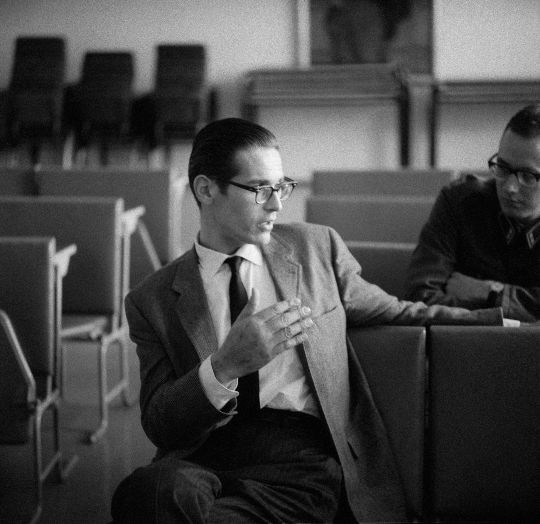
The Aesthetic of “Triune” Improvisation Reached by the Bill Evans Trio
In jazz piano trios up through the mid-1950s, the division of labor among the instruments was firmly fixed. As exemplified by the trios of Bud Powell and Oscar Peterson, the piano drove the melody and harmony with commanding momentum, the bass spelled out chord roots and meter through a regular four-to-the-bar walking bassline, and the drums maintained forward propulsion with ride-cymbal legato and hi-hat snaps on beats two and four. In other words, no matter how virtuosic the bassist and drummer might be, structurally they functioned as a foundation supporting the piano as lead voice.
Formed in late 1959 when Bill Evans brought together Scott LaFaro and Paul Motian, the group known as the “First Trio” gradually dismantled this hierarchy over roughly a year and a half of live performances and studio recordings (Portrait in Jazz and Explorations). Because Evans intentionally omitted chord roots from his left-hand voicings, regularly employing “rootless voicings” that stacked ninths, elevenths, and thirteenths atop the third and seventh degrees, a vast harmonic margin opened up in the lower register. Freed from the obligation to play the root on every beat, LaFaro used that open space not merely to fill in the bottom end, but as a register for a second melodic voice (counter-melody) conversing with the piano.
On his 1825 Abraham Prescott contrabass, LaFaro set the gut strings of the era unusually low and established a distinctive technique combining rapid two-finger pizzicato with the index and middle fingers alongside thumb work. His grace notes racing up into thumb position and continuous polyrhythmic triplets crossing barlines possessed a mobility that stepped into the territory of the cello or guitar. When Evans presented a brief motif and suddenly lifted his hands, in the very next instant LaFaro would imitate or invert that figure to carry it forward, while Motian punctuated their dialogue with brush sweeps and rimshots. Even though no one mechanically stressed the downbeat of the 4/4 meter, the shared internal pulse among the three never wavered, allowing the music to maintain a suspended tension without ever falling apart.
| Musical Element | Conventional Hard Bop Trio | 1961 Village Vanguard Trio |
|---|---|---|
| Piano Harmonic Voicing | Explicitly states roots, fifths, or shell voicings in the left hand | Secures midrange transparency through rootless voicings |
| Bass Range of Motion | Maintains meter via low-register four-beat walking bass | Improvises counter-melodies into thumb position with asymmetric lines and rests |
| Role of the Drums | Provides a steady groove on ride cymbal and hi-hat | Sculpts phrase breathing and negative space through shifting brush and cymbal colors |
| Treatment of Space and Rests | Fills spatial density with note count and volume | Frames intervals of silence using piano decay and subtle club room tone |
As summarized in the table above, what transpires on the Village Vanguard recordings is far more than the surface phenomenon of an active bassline. It is a chamber-music equilibrium made possible only through mutual subtraction: Evans thins out his notes to clear an entry path for LaFaro, and LaFaro steps off the downbeat so that Motian’s brushes can carve spatial depth. We trace the harmonic margins opened by modal jazz in detail in Modal Jazz and the Aesthetics of Ma (Negative Space), yet the Evans Trio occupies a solitary height in how it transformed that margin into three-part counterpoint.
Recording Engineering on June 25, 1961 – Orrin Keepnews and Basement Acoustics
Another indispensable protagonist in the musical value of this album is the architectural space of the Village Vanguard itself, located in a basement at 178 Seventh Avenue South in New York, paired with the on-site recording by producer Orrin Keepnews and engineer Dave Jones. Opened by Max Gordon in 1935, the club features an irregular wedge-shaped floor plan that narrows toward the back, where a low ceiling, exposed brick walls, and heavy red curtains generate distinctive early reflections and a short reverberation time (RT60). With barely a meter separating the stage from the front-row tables, the direct sound of the musicians’ instruments and the ambient sounds of the audience in the room cannot be physically separated.
On that Sunday, Keepnews and Jones brought a portable Ampex two-track tape recorder (custom Ampex 350-series equipment) into a corner of the club, capturing all five sets onto magnetic tape running at 15 ips using a minimal microphone setup. Microphones placed near the piano soundboard, beside the f-holes of LaFaro’s bass, and overhead above Motian’s drum kit captured the close-mic presence of each instrument clearly while refusing to artificially gate out bleed from neighboring instruments or the room ambiance of the audience. As a result, the friction of LaFaro’s fingers against the strings panned slightly to the left of the stereo field, the overtones of Evans’s Steinway spreading from center to right, and Motian’s brushwork wrapping the entire space from the rear left were fixed onto the same tape together with the layered air of the basement room.
Notably, even though brief voltage drops (dropouts) caused by the club’s electrical power supply occurred near the beginning and middle of the opening matinee track, “Gloria’s Step (Take 2),” Keepnews prioritized the extraordinary musical content and decided to include the take on the album. During quiet ballad passages, one can faintly hear the clear clink of a waitress setting down a glass, a low cough in the audience, and distant dishes. Whereas an ordinary studio recording would eliminate these environmental sounds as noise, here they function as a spatial scale indicating just how delicately Evans was voicing his pianissimo. Precisely because a trace of background room tone exists, the listener naturally leans in toward the decaying piano tones sinking even deeper behind it.
Structural Analysis of All Six Tracks on the Original Sunday at the Village Vanguard LP
Following LaFaro’s sudden death, Evans and Keepnews, still in deep grief, listened repeatedly through all the tapes from June 25 and compiled the first album, Sunday at the Village Vanguard, around the takes that most vividly documented LaFaro’s playing. The six tracks on the original LP (Riverside RLP 9392) are not a mere collection of best takes; opening with a LaFaro composition and closing with a LaFaro composition, they are sequenced with unmistakable memorial intent and musical symmetry.
1. Gloria’s Step (Take 2) – Floating Motion and Counterpoint in Five-Bar Phrases
Placed as the opening track of Side A, “Gloria’s Step” is an original composition written by Scott LaFaro himself. Its most striking structural feature is its rejection of the uniform thirty-two-bar (four-bar times eight) symmetry of a standard jazz tune, adopting instead a twenty-bar form combining two five-bar phrases (ten bars total) with a ten-bar continuation. Although the meter is 4/4, the harmony turns around in five-bar units, preventing the listener from predicting where the barline will land and creating a floating sensation in which the music moves forward as if perpetually suspended in midair.
Right from the theme statement, Evans’s right hand deliberately clips the tails of its phrases short, handing the fifth bar’s open space over to LaFaro’s fills. In the piano solo that follows, LaFaro runs a counter-melody mixing sixteenth notes and triplets alongside Evans’s nimble single-note lines, unfolding an exchange so dense that it becomes impossible to tell who is soloist and who is accompanist. When LaFaro enters his bass solo in the middle of the performance, Evans pares his keystrokes down to a minimum, limiting himself to softly placing tension chords from time to time. The melody spun from LaFaro’s fingertips betrays none of the heaviness typical of a low-register instrument, leaping as smoothly as a woodwind as it traverses the twenty-bar labyrinth.
2. My Man’s Gone Now – Gershwin’s Elegy and the Margin of Decaying Sound
The second track, “My Man’s Gone Now,” is a sorrowful aria from George Gershwin’s opera Porgy and Bess. At the opening, as Evans slowly raises the theme through single notes and dark minor-chord arpeggios, Motian alternates between mallets and brushes to create a gentle triple-meter sway resembling a funeral procession. Throughout the piece, Evans’s touch never strikes the keys percussively, instead resting weight into the bottom of the keybed and waiting for the overtones to bloom naturally.
What is especially unmissable here is the decay time between the instant the piano sounds a chord and the moment it moves to the next tone. Into the tiny gap just before a chord fades away completely, LaFaro gently slips a long high-register pedal point or descending line, bridging the dying resonance of the piano into the next measure. Rather than building a dramatic climax through sheer volume, this approach of paring away notes to throw the depth of grief into relief already points clearly toward the aesthetic of later quiet Blue Note sessions (see Five Classic Blue Note Albums for Listening to Negative Space) and European chamber jazz.
3. Solar – Metric Deconstruction of a Twelve-Bar Minor Blues
Closing Side A, Miles Davis’s “Solar” is built on a compact twelve-bar form, yet in the hands of this trio it transforms into a vast improvisational space in which barline boundaries virtually disappear. Refusing to mark the downbeat of the head explicitly, Evans slips into the performance with mid-stream phrasing, as if a conversation were already underway. As the short twelve-bar cycle revolves rapidly again and again, the three players deliberately blur the turnaround at the twelfth bar, joining multiple choruses into a single continuous breath.
Motian’s drumming here deserves special mention. Abandoning any fixed ride-cymbal pattern, every time LaFaro’s bass launches a syncopation across beat one, Motian ratifies and amplifies that accent on snare and ride cymbal. At the handoff from LaFaro’s solo to Evans’s solo, the rhythms of the three musicians trace multiple layers of polyrhythm (superimposing three-beat and five-beat accent groupings over 4/4 meter), erecting a three-dimensional acoustic architecture hard to believe is coming from a small acoustic trio.
4. Alice in Wonderland (Take 2) – The Sense of Flight Gained by a Jazz Waltz
Opening Side B, “Alice in Wonderland” (composed by Sammy Fain as the title song for the Disney film) is the signature jazz waltz that Evans cherished throughout his life. While preserving its accessible Broadway and Disney melody, Evans weaves chromatic inner voices and impressionistic parallel chords into the harmony, giving the piece an intellectual luster that never slips into sentimentality.
In a triple-meter piece, the bass ordinarily anchors the waltz’s center of gravity by playing a firm root on beat one (“oom-pah-pah”), yet partway through the head LaFaro leaves beat one empty, firing off phrases that spring from the upbeat of beat two or beat three. As a result, the rotational motion of the waltz lifts gently off the ground, synchronizing with the rapid scalar flights drawn by Evans’s right hand. Above the airy pathway created by Motian’s light brushwork, the sight of piano and bass overtaking and circling one another stands among the most joyous moments on the record.
5. All of You (Take 2) – Stillness and Motion Contrasted in a Cole Porter Standard
The following track, Cole Porter’s standard “All of You,” was also famed as a staple of the Miles Davis Quintet repertoire. The Evans Trio begins the tune in a restrained medium-tempo four-beat feel, structuring the performance so that its internal heat rises with each passing chorus. In the first half of Evans’s solo, he holds left-hand rhythmic comping to a minimum, offering linear improvisation in which a single-note right-hand line alone brings the skeleton of the chord progression into relief.
From the midpoint onward, when Evans begins pushing the rhythm forward with two-handed block chords, LaFaro alternates between walking bass and high-register counter-lines, sending the propulsion of the entire trio surging upward. On CD-era reissues and later expanded editions (such as the Keepnews Collection), Take 1 and Take 3 of this tune are included alongside Take 2, allowing listeners to compare empirically how, on the very same tune and the very same day, the angle of Evans’s opening phrase sends LaFaro and Motian’s responses along entirely different trajectories.
6. Jade Visions (Take 2) – The Meditative Finale Left Behind by LaFaro
Placed at the close of the original LP (Side B, Track 3), “Jade Visions” is another brief original composition by Scott LaFaro. In stark contrast to the dazzling virtuosity of “Gloria’s Step,” this piece is a deeply introspective, meditative miniature built from a slow tempo and a repeating short motif. Over a bass riff with a distinctive lilt that can be heard as 9/4 (or 4/4 plus 5/4), Evans quietly layers crystal-clear high-register chords.
Nowhere is there a fiery exchange of solos; instead, the performance unfolds as if the three musicians are simply immersing themselves in the same harmonic resonance and watching the sound dissolve into the room. Then the final chord is absorbed into the basement air, and after a brief hush, modest applause rises from the tables. For listeners in later eras who know of LaFaro’s death eleven days later, the lingering trail of “Jade Visions” carries a deep requiem resonance, as though he himself were lowering a quiet curtain on his musical life.
Contrast with Sister Album Waltz for Debby – “Light” and “Shadow” of the Same Night
Although Waltz for Debby (released in 1962), the other masterpiece born from the June 25, 1961 sessions, and Sunday at the Village Vanguard were recorded on the same day, in the same room, by the same three musicians, their characters as albums differ strikingly. Stated simply, that difference lies in the focus producer Orrin Keepnews gave to each record.
Whereas Sunday at the Village Vanguard places the late Scott LaFaro’s astonishing bass work and the trio’s thrilling contrapuntal interplay (the trio’s innovative, razor-sharp experimental spirit) at the forefront, Waltz for Debby was compiled around Evans’s lyricism as a pianist and his intimate singing touch on standard ballads. On tracks such as “My Foolish Heart,” which opens Waltz for Debby, the title piece written for his niece, and “Detour Ahead,” LaFaro holds back from extreme high-register leaps, spinning warm low-register lines that embrace Evans’s melody from just behind.
Only by listening to both albums back to back does the full musical amplitude of June 25, 1961 come into view. Right beside “Solar” and “Gloria’s Step,” which slice through space with taut polyrhythms, stood the gentle harmony of “My Foolish Heart” melting into the clink of cocktail glasses. That both extremes arose naturally from the shared breath of the same three players is the clearest proof of the rare perfection this trio had attained in jazz history.
The Intelligence That Guided Classical Impressionist Harmony into Jazz
The reason Bill Evans’s piano never turns noisy no matter how intricate his improvisation becomes, always preserving a cool stillness, lies in the classical training he cultivated from childhood. Having majored in classical piano and music education at Southeastern Louisiana University, Evans had thoroughly internalized the colorful harmonic language of modern French music and Baroque counterpoint, from Debussy, Ravel, and Scriabin to Rachmaninoff and Bach’s The Well-Tempered Clavier.
His experience joining the Miles Davis Sextet from 1958 to 1959 and playing a central role in the making of the historic landmark Kind of Blue (see our Guide to Miles Davis’s Kind of Blue) purified Evans’s harmonic sensibility even further. Rather than being chased by rapidly shifting chord changes, this technique stays inside the resonance of a single mode or chord, painting gradations of color solely through keystroke depth and subtle pedaling. Throughout the Village Vanguard recordings, one can hear moments where Evans operates the damper pedal with delicate half-pedaling, allowing a trace of the previous chord’s overtones to linger and blur into the next harmony.
This pianism, which lets the listener hear the process by which sound blends in space and fades away (decay and release) rather than the percussive attack of the note, was passed straight down to Keith Jarrett’s solo improvisations (see our Guide to Keith Jarrett’s The Koln Concert) and the spatial aesthetics of the ECM label founded by Manfred Eicher. The introspective resonance Evans sounded in a small basement jazz club transcended the frame of American jazz to become the headwaters of a universal “music for quiet listening” that speaks directly to modern ambient and post-classical listeners as well.
Listening Checkpoints Across Audio Setups and How to Choose a Remastered Edition
More than half a century after its recording, Sunday at the Village Vanguard exists in numerous mastering versions, from original analog pressings to CD, SACD, and high-resolution digital streams. Understanding the sonic signature of each makes it easy to choose the ideal edition for your home playback setup, whether loudspeakers or headphones.
The first listening checkpoint to note is the stereo placement and woody body resonance of Scott LaFaro’s bass on Track 1, “Gloria’s Step,” and Track 2, “My Man’s Gone Now.” On the two-track recording of the era, the bass is positioned toward the left channel, the piano from center to right, and the drums from left to rear center. Listening on headphones emphasizes the left-right separation so that the finger movements of all three players can be tracked microscopically, whereas playing the album over speakers from a comfortable distance allows the left and right channels to blend naturally in the air of the room, raising the depth of the Village Vanguard stage and the presence of the audience in three dimensions.
Among currently accessible releases, three main lineages stand out. First, if you value the original six-track LP sequence and a warm mid-bass balance, the standard Original Jazz Classics (OJC) remaster or a 180-gram heavyweight vinyl LP cut from the analog master tapes provides the most natural listening feel. Second, if you want to trace the full scope of the sessions including alternate takes from the same day (such as “Gloria’s Step (Take 3),” “Alice in Wonderland (Take 1),” and “All of You (Take 1 / Take 3)”), the Keepnews Collection edition supervised by Orrin Keepnews himself or current CD and streaming editions with bonus tracks are well suited. Third, if you wish to draw out every last detail of LaFaro’s string friction and the delicate overtones of clinking glasses, choosing the 192kHz/24-bit high-resolution digital edition or the hybrid SACD reveals the astonishing wealth of information captured on the magnetic tape.
Listening link: Listen on Apple Music / Listen on Spotify
Furthermore, consulting The Complete Village Vanguard Recordings, 1961 (Riverside 3CD), which sequences all five sets from June 25, 1961 in chronological order, lets you hear firsthand how the breathing of the three musicians warmed up and how the spaces between their notes expanded from the opening afternoon matinee set to the final set of the night. “Gloria’s Step,” for example, survives in both an afternoon Take 2 (the take selected for the original LP) and an evening Take 3: whereas the afternoon take races through with taut tension and razor-sharp syncopation, the evening take features wider tempo elasticity (close to rubato) and a more singing phrasing in LaFaro’s solo. Precisely because this music could change shape so freely even within the span of a single day, the loss eleven days later left an irreplaceable void in jazz history.
Conclusion – Listening to the Stillness While Knowing What Happened Eleven Days Later
After Scott LaFaro passed away eleven days after this recording, the shock kept Bill Evans away from public trio performances for roughly half a year. Although Evans would go on to leave behind many celebrated recordings with great bassists such as Chuck Israels, Eddie Gomez, and Marc Johnson, the miraculous equilibrium that rang out at the Village Vanguard on June 25, 1961, in which three musicians sang at the same time and fell silent at the same time, belonged to that afternoon and night alone. Late at night in a quiet room, turn the volume down slightly and listen closely to the instant a piano chord fades away and the margin where LaFaro’s bass glides in.
Primary sources and official archive references: Concord / Craft Recordings official catalog (Craft Recordings Official / Original Jazz Classics OJC-140 / Riverside RLP 9392), 1961 live session production notes and liner notes by producer Orrin Keepnews, and verification of basic album information: Sunday at the Village Vanguard (Wikipedia Japanese edition, verified August 5, 2026).
Editor’s Note
This is a classic record where even the faint clinking of glasses at the tables of the Village Vanguard feels endearing. The moment LaFaro’s bassline leaps up as if conversing directly with Evans’s keyboard reminds us that jazz has always been an art of free dialogue.