Released in May 1997, Radiohead’s third album OK Computer stands as a paradigm shift in acoustic design and the recording process within popular music. The record grew out of a direct reaction against the formalist songwriting of Britpop, then dominant in the United Kingdom, and against guitar ensembles built on excessive overdubbing. Leaving behind conventional, enclosed studio environments, the five members of Radiohead and co-producer Nigel Godrich pursued a series of acoustic experiments: capturing the physical reverberation of a historic mansion, combining early digital equipment with analog tape in a hybrid workflow, and treating the room itself as an instrument. Based on objective facts and first-hand testimony, this article examines the historical context of the sessions, the spatial recording strategies at St Catherine’s Court, the specific gear and technical approaches used, and the structural characteristics of nine key tracks.
Related reading: Rich Sound at Low Volume – The Technique and Philosophy of Late-Night Listening
Reaction Against Britpop and the Philosophy of Bitches Brew
When work on OK Computer began in 1996, the British music industry was at the height of Britpop, led by bands such as Oasis and Blur, churning out loud, straightforward guitar arrangements and vocal melodies built for crowd sing-alongs. Although Radiohead had achieved commercial success with their 1995 second album The Bends, frontman Thom Yorke was confronting both his own symbolic consumption as a stylized rock star and severe mental and physical exhaustion from an extended world tour.
Guitarist Jonny Greenwood later described the band’s mindset at the time: “We wanted to break out of the formula of simply putting lyrics over a chord progression and blasting it through loud guitars. Beyond the strength of the songwriting itself, we wanted to present the acoustic structure as the work: how sounds are placed inside the speakers and what kind of texture they carry.”
As their primary sonic role model for the album, the band pointed to Miles Davis’s radical 1970 jazz record Bitches Brew. Speaking about the soundscape of Bitches Brew, Thom Yorke noted: “Every instrument occupies its own distinct space, yet the whole thing functions organically like a single giant organism. We wanted to recreate that density, and that way of capturing the ‘air’ between the instruments, within the format of a rock band.”
The band also studied the minimalism of the Krautrock group Can and the atonal, dissonant textures of Polish contemporary composer Krzysztof Penderecki. Their first step toward digesting these diverse influences was to walk away from traditional recording environments such as London’s premier Abbey Road Studios.
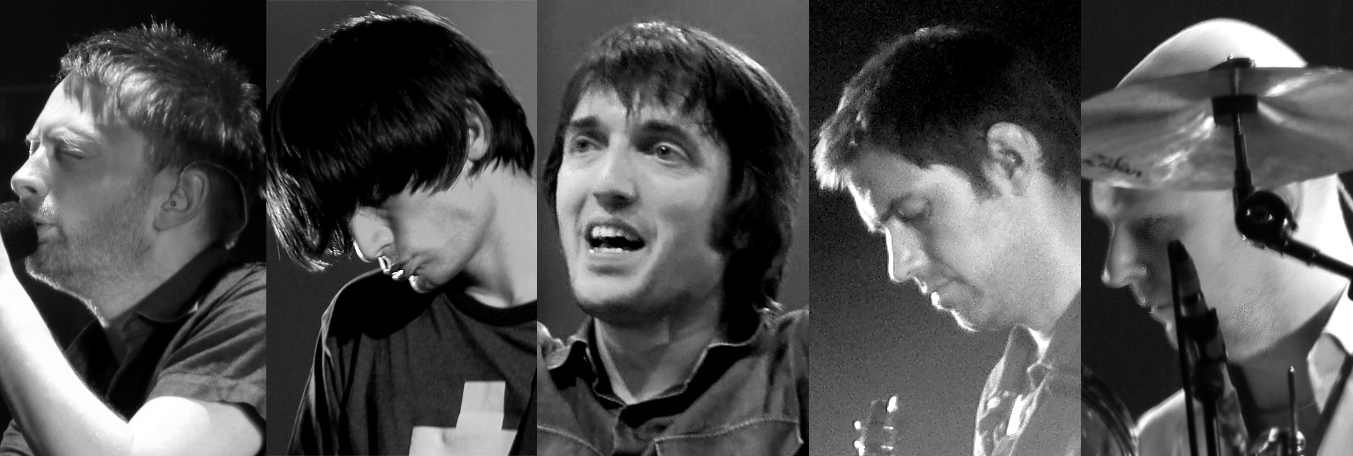
Spatial Acoustic Experiments at St Catherine’s Court
In September 1996, carrying their own mobile recording rig, “Canned Applause,” purchased with an advance from EMI, the band rented St Catherine’s Court, a historic manor house near Bath in Somerset, southwest England. Owned at the time by actress Jane Seymour, the 15th-century listed property had none of the soundproofing walls or acoustic absorption panels found in conventional recording studios.
This “uncontrolled, live architectural space” became the laboratory for Nigel Godrich and the band. Godrich set up the sessions to use the distinct acoustic response of each room as an instrument in its own right.
- The stone stairwell resonance on “Exit Music (For a Film)”
- The ballroom recording on “Let Down”
- The natural echo chamber on “Subterranean Homesick Alien”
This physical room resonance produced a gradation of air, complete with a distinct sense of depth and natural distortion, that cannot be replicated in modern studio work where every instrument is isolated in a separate booth with close multi-miking.
Hybrid Architecture: Early Digital Gear Meets Analog Tape
The recording of OK Computer took place in a hybrid environment combining a 24-track analog tape recorder (an Otari MTR-90) with early hard-disk recording systems (primarily early versions of Cubase and Pro Tools). In a setup that was cutting-edge for its era, what stands out is how the equipment was deployed specifically for sonic degradation and textural control.
Drum Sampling and the Use of the AKAI S3000
The fragmented drum loop heard on “Airbag” was built by taking a few seconds of live drums played by Philip Selway, feeding them into the era-standard AKAI S3000 sampler, and manually slicing and reconstructing them in an early version of Cubase on a Macintosh. As Thom Yorke explained: “Instead of simply looping a clean beat, inserting microscopic moments of silence (mutes) between the sliced samples created an awkwardness and tug that no human performance could produce.” That digitally sliced waveform was then recorded back onto analog tape at hot input levels to saturate it, adding warm low-mid weight.
Ed O’Brien’s AMS DMX 15-80S and Self-Oscillating Noise
Guitarist Ed O’Brien stepped back from the traditional role of playing melodies and chord voicings, treating his guitar instead as a generator of sonic texture. His main setup paired a Gibson ES-335 guitar with the legendary 1980s AMS DMX 15-80S digital delay and a Roland RE-201 Space Echo.
The low, crawling oscillation noise at the end of “Karma Police” was created by Ed sending his guitar signal into the AMS delay and manually turning the delay-time knob to push the feedback loop into self-oscillation. Godrich recorded this live as a performance gesture, riding the faders of the custom Neve console to control the oscillating electrical noise before pulling it down in a sudden fade-out at the very end of the track.
Jonny Greenwood’s Ondes Martenot and Analog Pedals
Drawing on his classical training, Jonny Greenwood introduced the Ondes Martenot, an early electronic instrument invented in France in the 1920s, beginning on this album. The wavering, theremin-like sine-wave tones heard in the background of “Paranoid Android” and “No Surprises” were played by Jonny on an original unit. He also used analog phasers such as the Mu-Tron Bi-Phase and vintage pedals like the Shin-ei FY-2 Companion Fuzz to carefully design timbres rich in impurities, far removed from modern clean guitar tones.
Acoustic Structure and Technical Approach Across Nine Tracks
The following section examines nine core tracks from the album, detailing the specific recording techniques, equipment settings, and objective arrangement choices used on each piece.
“Airbag”
The album’s opening track takes traffic accidents and survival as its theme. Its defining acoustic feature is the fusion of digital drum sampling and analog tape dubbing described above.
- Beat structure
- Colin Greenwood’s bass approach
“Paranoid Android”
A suite of more than six minutes linking three distinct sections. While inspired by the Beatles’ “Happiness Is a Warm Gun,” its technical treatment is thoroughly modern.
- Irregular 7/4 meter and cabasa
- Jonny’s frenetic guitar solo
- Ondes Martenot choir layer
“Subterranean Homesick Alien”
A floating triple-meter track that comes closest on the album to Miles Davis’s modal jazz.
- Effect processing on the Fender Rhodes
- Ed’s textural guitar layers
“Exit Music (For a Film)”
Written specifically for Baz Luhrmann’s film Romeo + Juliet, the piece was engineered with a wide dynamic arc to score the film’s closing credits dramatically.
- Ultra-close miking on the vocal and acoustic guitar
- The fuzz-bass detonation
“Let Down”
Blending intricate polyrhythms with spatial engineering, this is one of the most technically complex recordings on the album.
- Polyrhythmic architecture
- Spatial placement of overdubbed vocals
“Karma Police”
A piano-driven piece where traditional acoustic arrangement collides with cutting-edge digital processing.
- Neve console saturation
- Ed O’Brien’s self-oscillating delay
“Climbing Up the Walls”
An industrial-tinged track featuring the most experimental and unsettling acoustic design on the record.
- Sixteen-part string tone cluster
- Real-time sampling of a portable radio
“No Surprises”
The album’s signature acoustic lullaby, stripped down to an extreme economy of notes.
- Pitch manipulation on Thom’s vocal
- Fusion of acoustic guitar and glockenspiel
“The Tourist”
The album’s closing track, a slow triple-meter heavy ballad placed as an explicit antithesis to speed and technology.
- Deliberate deceleration and breaks
- The decaying resonance of the final triangle strike
Visual Negative Space in the Artwork and Stanley Donwood’s Philosophy
The packaging of OK Computer gives visual form to the acoustic negative space inside the music. The artwork was created by the band’s longtime visual partner Stanley Donwood together with Thom Yorke (credited under the moniker “The White Chocolate Farm”).
They built an abstract visual world in blue and white by layering computer-generated graphic collages over rough hand-drawn sketches. Scattered across the pages are motorway signs, eerie diagrams, pictograms resembling emergency drill instructions, and scrawled, enigmatic phrases such as “LOST CHILD” and “PROKOFIEV.”
What stands out most, however, is the vast expanse of white negative space surrounding those figures.
Donwood later explained the thinking behind this design process: “We wanted to create an antithesis to the loud, psychedelic, or primary-color-drenched graphics that filled record shops at the time. The blank white space is the cold glow of an LCD screen, and at the same time it is a void where information has dropped out. What you see there is the process of words and images losing their meaning.”
During production, Donwood deliberately refused to use the computer’s “Undo” command, leaving operational slips, unexpected image degradation, and error messages intact as part of the design. This method corresponds directly to Nigel Godrich’s musical approach of preserving digital delay oscillation, analog tape overload distortion, and raw room reverberation as “imperfect beauty.” The white negative space of the sleeve resonates with the silence inside the music, acting as a decisive visual trigger that makes the listener aware of physical quiet.
The Critical Power of Negative Space in the Streaming Era
The premonition that Thom Yorke and his bandmates confronted in 1997 – the flood of technological information and the reduction of the individual to a symbol – has become everyday reality in the 21st-century streaming environment. Through our smartphones we can access tens of millions of jazz and rock tracks in an instant, yet our ears are simultaneously managed by the algorithms of the attention economy.
On today’s streaming platforms, music is homogenized into playlists and consumed efficiently as background audio or mood wallpaper for work. At the slightest hint of a slow passage or a gap in the sound, listeners instinctively tap the skip button and move on to the next piece of content. This elimination of blank space is the governing rule of contemporary music consumption.
In that context, approaching the acoustic design of OK Computer as an exercise in listening to negative space can serve as an active intervention against the attention economy.
In particular, the radically pared-back, subtractive ensemble of “No Surprises,” or the decay of the triangle at the end of “The Tourist” and the silence that follows it, demands that the listener lean in and listen actively.
When you turn off smartphone notifications, lower your speaker volume just slightly below your usual setting, and play this record, you begin to notice microscopic sonic details that remain hidden at high volume: the sound of Thom’s breath in the first half of “Exit Music,” the friction of fingers sliding along acoustic guitar strings, or the fading tail of the Fender Rhodes reverb wavering behind “Subterranean Homesick Alien.” Lowering the playback volume drops the listener’s own internal noise floor, allowing these contours to emerge in sharper relief.
Where streaming normalization tends to flatten dynamic range into a uniform loudness, consciously turning down the volume knob lets us reconstruct that dynamic scale within our own perception. The negative space of OK Computer is not passive background silence; it is a critical apparatus for resetting ears numbed by information overload and hearing the “unplayed sound” behind everyday noise.
Conclusion: The Acoustic Essence of OK Computer
The greatness of Radiohead’s OK Computer goes far beyond its prophetic lyrics about technological alienation. Its essence lies in the remarkably intricate, physical acoustic experiments carried out inside the real architectural space of St Catherine’s Court near Bath and Oxford, running early digital gear and analog tape in tandem.
Subtracting away the dense guitar walls of contemporary Britpop, Nigel Godrich and the five band members reconstructed within a rock-band format the sense of room air and spatial resonance that Miles Davis had pioneered on Bitches Brew.
Late at night, dim the lights in your room and turn your speaker volume just a hair counter-clockwise. Then listen closely to the silence that lingers after the album’s final triangle strike fades away. Right there, in the quiet, rings the true “sound that is not there” that Radiohead sought to capture in the cold manor-house air of 1997.
Related reading: Alternative Rock Primer – Subtraction and Negative Space / Related reading: Rich Sound at Low Volume – The Technique and Philosophy of Late-Night Listening
Deep Dive: Between Digital and Analog – The Alienation Mapped by OK Computer
Released by Radiohead in 1997, OK Computer is often described as “the 1990s The Dark Side of the Moon (Pink Floyd)” or “the outer limit of rock.” Yet the true achievement of the album lies in how it turned fin-de-siecle anxiety over technology’s rapid encroachment on society into pure acoustics through a seamless fusion of guitar rock and electronics.
Recorded with co-producer Nigel Godrich at the historic St Catherine’s Court manor house, the natural reverberation of stone halls gives the entire record a gothic, chill spatiality. The contrast heard on tracks like “Let Down” and “Exit Music (For a Film)” between the raw resonance of acoustic guitar and the synthetic noise of Mellotron and synthesizers vividly captures the process of warm-blooded human beings being swallowed by mechanical coldness.
Deconstructing the “Rock Band” Format
The album’s centerpiece, “Paranoid Android,” takes the form of a suite that forcefully welds together three distinct sections without a conventional chorus. With Jonny Greenwood’s heavily processed, violent guitar solos intersecting Thom Yorke’s falsetto, the track stood as an unmistakable declaration of departure from the optimism of the Britpop movement.
Although the success of OK Computer elevated Radiohead to the status of the world’s biggest rock band, they refused to rest on that position, casting aside guitars altogether on their next album Kid A to dive into the depths of electronica. OK Computer remains a vital singularity in music history: a vivid recording of the exact moment a rock band challenged the limits of the rock format and stepped into an uncharted acoustic space beyond it.
Perhaps the true essence of this record lives in the presence that lingers in the room after the notes have stopped ringing. Take a moment to listen into the spaces between each sound.