In the mid-1990s, the Chicago band Tortoise reimagined the recording studio not as a passive documentation medium, but as a single vast musical instrument, decisively shaping the acoustic language of post-rock. Combining analog tape and early hard-disk recording at John McEntire’s Soma Electronic Music Studios with the polyrhythms of twin drum kits and marimbas, the deconstructive editing aesthetic crystallized on Millions Now Living Will Never Die and TNT left an irreversible mark on subsequent electronica and contemporary jazz.
Dismantling Narrative: Post-Rock as Acoustic Craft
Coined in 1994 by music critic Simon Reynolds in the pages of the British magazine The Wire, the term “post-rock” served above all to describe the singular musical practices emerging from Chicago around Tortoise. It denoted an approach that used standard rock instrumentation while dismantling traditional rock narratives—such as flashy guitar riffs and cathartic vocal hooks—to push acoustic space and texture itself to the foreground.
At the time, the alternative rock landscape was caught in the crest and backlash of grunge. As distorted guitar walls and raw vocal self-expression hardened into convention, the members of Tortoise chose radical subtraction and objectivity. Eliminating vocals altogether, they arranged two basses, two drum kits, and mallet percussion such as marimbas and vibraphones on a horizontal plane, building an ensemble in which no single instrument claimed the spotlight. As traced in our History of Alternative Rock, it was a symbolic moment when punk’s DIY impulse pivoted toward the architectural intelligence of the recording studio.
The heart of Tortoise’s acoustic craft lay not in the raw heat of live performance, but in the editing process: how recorded tape and digital audio data were dismantled and repositioned inside three-dimensional space. Rather than reaching completion in a single live-in-the-room take by the full band, a piece received its final form only upon the studio mixing console. This philosophy of reconstruction through sound became the cornerstone of the global movement explored in our Introduction to Post-Rock.
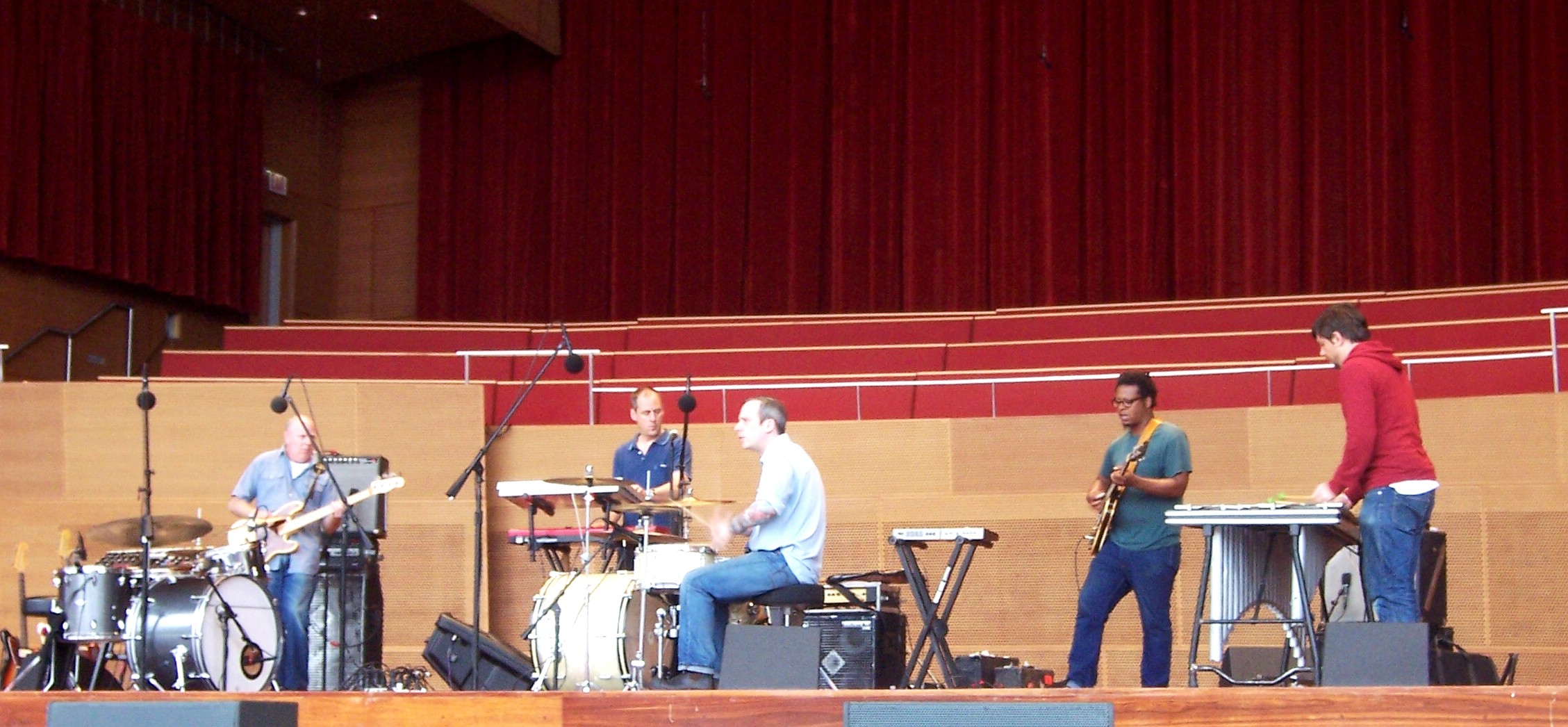
The Spatial Aesthetics of Soma Electronic Music Studios: Turning the Studio into a Vast Instrument
No account of Tortoise’s groundbreaking sound can bypass Soma Electronic Music Studios, the Chicago recording facility founded by drummer and engineer John McEntire. Having honed his engineering craft at Idful Music Design, McEntire established Soma in 1995 to provide a dedicated laboratory capable of accommodating the sprawling experiments of his own bands and peers.
Soma’s defining feature was its pragmatic marriage of top-tier analog hardware with early digital recording technology. While Studer and Otari 2-inch, 24-track analog tape machines captured warm low-end magnetic saturation, newly introduced Pro Tools rigs and hard-disk recorders handled waveform-level splicing and time-domain manipulation. McEntire treated the entire studio as a single giant signal processor, riding console faders and repatching the patchbay with the exact same musical instinct as plucking a guitar string.
Rather than a dead acoustic room stripped of all reflections, Soma’s live space preserved a balanced sense of air shaped by wood and concrete surfaces. In his microphone setups, McEntire skillfully blended close microphones capturing direct attack with ambient room microphones placed in the corners of the studio, carving out vivid depth and three-dimensional relief. The enclosed room of the studio itself breathed as an indispensable sixth member on every Tortoise record.
The signal-routing architecture at Soma Electronic Music Studios merits closer inspection as well. Centered around a custom Neotek console, the microphone preamp outputs feeding each channel were split simultaneously to both analog multitrack tape and the Pro Tools audio interfaces. This allowed the band to run a permanent hybrid workflow: capturing live takes through the natural magnetic compression of tape while simultaneously pulling them into a non-destructive digital editing environment.
In selecting spatial outboard effects, vintage and modern classics—including an EMT 140 plate reverb, Lexicon digital delays, and a Roland RE-201 Space Echo—were routed freely across the patchbay. Beyond recording guitar and bass amplifiers directly, McEntire routinely printed reversed delay returns to separate tracks and layered them out of phase against the dry signal, practicing painstaking acoustic joinery at the mixing stage night after night.
Track-Building on the Landmark Album Millions Now Living Will Never Die
Released in 1996 on the flagship Chicago label Thrill Jockey, Tortoise’s second album Millions Now Living Will Never Die stands as the monument where the band brought their studio craft to its first summit. Opening the record is the 20-minute-53-second epic “Djed,” which remains a touchstone of post-rock composition to this day.
An acoustic analysis of “Djed” reveals roughly six distinct sections joined together at once seamlessly and jarring by design. The piece begins with a minimalist, Krautrock-descended motorik hammer beat and interlocking basslines. Gradually, sustained analog synthesizer tones and melodica accumulate, thickening the sonic density. Just before the performance reaches a conventional climax, however, reversed tape cues and digital-glitch-like ruptures cut straight across the mix, dismantling the ensemble in an instant.
In the section that follows, dub-inspired deep delay and cavernous reverb open up a vast soundstage where each mallet and drum stroke spreads outward like ripples across dark water. In the latter half, modulated guitar noise and polyrhythmic marimbas intersect before settling into a hushed ambient drone. Across this twenty-minute sonic voyage, live ensemble groove and physical tape-splice ruptures are treated as completely equal compositional materials, fundamentally updating what a “song” in rock music could be.
The recording of the album was completed by taking countless fragmentary phrases brought in by bassists Dan Bitney and Douglas McCombs, alongside then-guitarist David Pajo, which McEntire sliced apart on tape and spliced back together. Even accidental performance slips and amplifier hum were elevated through frequency sculpting and spatial placement into deliberate aesthetic elements.
The tracklist and recording architecture of all six pieces on Millions Now Living Will Never Die are summarized below. Recorded primarily at Soma in Chicago, the album was engineered and mixed by John McEntire.
| Track | Title | Duration | Primary Instrumentation & Acoustic Features |
|---|---|---|---|
| 1 | Djed | 20:53 | Twin basses, Moog synthesizer, marimba, physical tape manipulation |
| 2 | Glass Museum | 5:27 | Vibraphone, clean guitar, jazz drum phrasing, wide dynamic swings |
| 3 | A Survey | 2:52 | Overlapping low-end from two basses, minimalist phrase repetition |
| 4 | The Taut and Tame | 5:01 | Aggressive twin drums, overdriven organ, post-hardcore energy |
| 5 | Dear Grandma and Grandpa | 2:49 | Electronic noise, reversed tape loops, environmental sound collage |
| 6 | Along the Banks of Rivers | 5:50 | Douglas McCombs’s restrained six-string bass, hushed guitar, spatial reverb |
The sequencing of the tracks is calculated with precision. After “Djed” lays out the full scope of the band’s studio experiments, “Glass Museum” pivots from serene, melodic vibraphone figures into an explosive late-track drum break. Paired with the natural saturation of analog tape, that immense dynamic range grips the listener’s ear from start to finish.
Seamless Editing Aesthetics and the Arrival of Jeff Parker on TNT
On their third album, TNT (1998), Tortoise evolved further still. The single biggest turning point on the record was the full-time addition of guitarist Jeff Parker, a veteran of Chicago’s improvised jazz community. The sophisticated chord voicings and improvisational poise Parker brought to the band introduced fresh harmonic color and depth into Tortoise’s acoustic architecture. As explored in our guide to Jeff Parker’s Guitar Work, his restrained tone relies not on heavy distortion or artificial sustain, but on an acute spatial awareness that makes the intervals between notes ring out.
On the technical front, TNT was produced by embracing hard-disk recording across the board. Individual band members came into the studio one by one, recording improvisations onto the hard drive against click tracks or existing fragments. McEntire then edited those sprawling audio regions inside Pro Tools with microscopic precision, assembling an intricate puzzle in which it is often impossible to tell who played what or when.
Exemplifying this method are the title track “TNT” and “Ten-Day Interval.” On “Ten-Day Interval,” marimba and piano panned across the left and right channels trace unhurried loops in contrasting meters while electronic tones and live drums weave organically around them. The boundary between live performance and digital loop is erased completely. Crisp digital editing and the warm wooden resonance of the vibraphone hold a remarkable equilibrium, creating a sonic garden where organic touch and studio technology merge.
By surrendering the traditional rock ideal of “a band playing live in one room” from the outset and structuring fragmented sonic textures on the timeline, the methodology of TNT paradoxically succeeded in forging a remarkably cohesive, graceful ensemble sound.
Across all twelve tracks on TNT, hard-disk recording supports a meticulously constructed musical architecture. The full tracklist and the acoustic design of each piece are detailed in the table below.
| Track | Title | Duration | Primary Acoustic Techniques & Ensemble |
|---|---|---|---|
| 1 | TNT | 7:33 | Jeff Parker’s guitar riffs, synchronization of live drums and programming, cornet |
| 2 | Swung from the Branches | 4:15 | Left-right marimba panning, ambient electronic pulses |
| 3 | Ten-Day Interval | 4:44 | Piano and marimba polyrhythms, layered minimalist patterns |
| 4 | I Set My Face to the Hillside | 6:08 | Nylon-string guitar, cello, slow-tempo Latin percussion |
| 5 | The Equator | 3:42 | Jazz-fusion inflection, warm Fender Rhodes modulation |
| 6 | A Simple Way to Go Faster Than Light That Does Not Work | 3:33 | Fragmented high-speed breakbeats, undulating fuzz bass |
| 7 | The Suspension Bridge at Niagara Falls | 5:39 | Melodic bassline, spatial delay processing, acoustic ensemble |
| 8 | Four-Day Interval | 4:45 | Variation on “Ten-Day Interval,” layered synthesizers and slow-motion pacing |
| 9 | In Sarah, Mencken, Christ, and Beethoven There Were Women and Men | 7:23 | Heavy dubwise spatial processing, deep sub-bass modulation |
| 10 | Almost Always Is Never Enough | 2:42 | Glitch noise, sampled beats, fragmentary keyboard figures |
| 11 | Jetty | 8:21 | High-speed electronica beat reconstructed from the latter module of “Djed” |
| 12 | Everglade | 4:21 | Hushed outro, Tortoise’s chamber-rock closing statement |
Especially noteworthy is Track 11, “Jetty,” which digitally resamples multitrack stems from the closing section of “Djed” on Millions Now Living Will Never Die and reconstructs them into an entirely independent composition. Treating even their own past recordings as raw sampling material to be dismantled and reused on equal footing stands as definitive proof of how thoroughly Tortoise transplanted the sampling culture of hip-hop and electronic music into a live band format.
Minimalism and Polyrhythm Woven by Twin Drums and Twin Marimbas
Both on stage and in the studio, Tortoise’s most distinctive physical signature lies in its unorthodox percussion setup anchored by twin drum kits and twin marimbas (or vibraphones). Every member of the group is a multi-instrumentalist, routinely swapping stations mid-set—a drummer stepping over to play bass while a bassist takes up mallets behind the marimba.
The interplay between drummers John Herndon, John McEntire, and Dan Bitney is never designed simply to double the volume. Panned wide to the left and right stereo channels, the two drum kits carry contrasting hi-hat subdivisions and kick-drum accents, generating intricate phase shifts and three-dimensional depth across the stereo stage. While one kit supplies a dry jazz groove, the other layers abstract brushwork or rimshots against it, producing an organic undulation rather than a rigid linear pulse.
Layered atop that foundation, the mallet strikes of the twin marimbas bring the techniques of minimalist composition—Steve Reich and Philip Glass—directly into a rock context. The dry woody attack of the bars and the brief resonant sustain of the resonator tubes fill the midrange spectrum (500 Hz to 2 kHz) with warmth, claiming the melodic midrange territory traditionally monopolized by electric guitars. At once percussive and melodic, the marimba is what keeps Tortoise’s music from feeling like sterile electronica, lending it a supple human warmth.
The Chicago Post-Rock Network — Cross-Pollination with The Sea and Cake and Gastr del Sol
Tortoise’s innovations did not arise in isolation; they were nurtured inside a tightly knit network of 1990s Chicago musicians. Cross-pollination with Sam Prekop’s band The Sea and Cake and the duo Gastr del Sol—comprising Jim O’Rourke and David Grubbs—deepened the shared musical vocabulary across the entire city.
John McEntire served concurrently as drummer and producer for The Sea and Cake, making Soma Studios a shared experimental workshop for the whole circle. Musicians who had come up through fierce post-hardcore and noise-rock bands such as Bastro, Slint, and Eleventh Dream Day were absorbing free jazz, Brazilian music, and twentieth-century avant-garde composition, competing quietly in a cold Midwestern city to refine the purity of their sound.
What united them was an aesthetic refusal to show off technical flash for its own sake, paired with an intense devotion to the physical grain of recorded sound. Dismantling rock from the inside out and expanding it toward film scores and electronic music, the Chicago post-rock movement radiated out to listeners worldwide with Tortoise as its gravitational center.
Tortoise’s Legacy Across Contemporary Post-Rock and Electronica
The approach Tortoise pioneered—treating studio production itself as acoustic craft—exerted an immense influence on music from the 2000s onward. Spreading far beyond indie rock, its branches reached into folktronica, IDM, post-dubstep, and contemporary progressive jazz.
Kieran Hebden, known as Four Tet, has openly cited Tortoise as a decisive influence on his method of weaving acoustic instrument samples together with electronic beats. Similarly, the loop-driven, odd-meter ensemble architecture of Battles (founded by former Don Caballero guitarist Ian Williams and Dave Konopka) and the organic psychedelia of Dan Snaith’s Caribou directly inherit the dissolution of the boundary between live playing and studio production that Tortoise demonstrated.
From their collaborations with Stereolab to the improvised beat-making of contemporary Chicago jazz figurehead Makaya McCraven, the seed Tortoise planted—dismantling live performance as raw material and reconstructing it in the studio—has taken root as a shared lingua franca across border-crossing modern music.
Acoustic Checkpoints for Your Listening Setup: What to Listen for on Audio Gear
Tortoise’s catalog—above all Millions Now Living Will Never Die and TNT—serves as an exceptional reference recording for testing the resolution and spatial imaging of headphones and hi-fi speaker systems. Key acoustic checkpoints to focus on while listening are outlined below.
| Acoustic Checkpoint | Reference Track & Passage | What to Listen for on Your Audio System |
|---|---|---|
| Sub-bass definition and damping | Opening bassline of “Djed” | Check whether the 40 Hz to 60 Hz sub-bass remains articulate without muddying, separating cleanly from the attack of the kick drum on closed-back headphones or full-range speakers. |
| Stereo soundstage width | Marimbas on “Ten-Day Interval” | Listen for pinpoint left-right imaging of the mallet percussion and a tangible sense of front-to-back depth in the center of the room. |
| Low-level signal decay | “I Set My Face to the Hillside” | Follow the purity of the decay as plucked acoustic guitar notes and vibraphone resonances fade into the natural air of the studio room. |
| Unstrained high-frequency extension | “The Suspension Bridge at Niagara Falls” | Notice whether intricate hi-hat and cymbal subdivisions (8 kHz to 12 kHz) decay smoothly without harshness or sibilant glare. |
Tortoise’s mixes stand at the opposite pole from modern commercial mastering that crushes dynamic range with heavy-handed compression to maximize loudness. Because wide dynamic headroom is preserved throughout, turning your amplifier volume up slightly higher than usual brings out the subtle tape hiss and quiet room tone lurking in the soft passages, allowing you to experience the full physical depth of John McEntire’s studio craft.
Primary Sources and References
The discographical data, studio equipment specifications, personnel credits, and critical history examined in this article are compiled from the following primary and official sources.
| Source / Label | Covered Works & Scope | Published Details & Verification Date |
|---|---|---|
| Thrill Jockey Records Official Discography | Tortoise, Millions Now Living Will Never Die, TNT | Official discography and personnel credits (verified September 28, 2026) |
| Soma Electronic Music Studios Archives | Recording equipment list and studio specifications | Analog tape machines (Otari / Studer) and Pro Tools system architecture (verified September 28, 2026) |
| The Wire Magazine (Simon Reynolds) | Post-rock critical discourse and 1994 essay | Definition and historical archive of post-rock criticism (verified September 28, 2026) |