Visionary Electronics That Foretold the Computerized Society
Released in 1981, Computer World stands as a landmark by electronic music pioneers Kraftwerk. Pairing a conceptual vision of a future governed by computers with unexpectedly wistful, nostalgic melodies, the album exemplifies the German electronic aesthetic woven from minimal rhythm machines and precision synthesizers.
Reference: Music – Wikipedia
For more on the minimal structures and spatial design created by repeating electronic tones, see our site’s guide to the roots of electronic music.
In 1981, long before personal computers and the internet became everyday household realities, Kraftwerk foresaw a society linked together by data and communication networks. Rather than delivering a grim dystopian warning, they presented that vision as pop art tinged with quiet melancholy. Led by Ralf Hütter and Florian Schneider, the group anticipated the arrival of today’s big-data and AI society in sound more than forty years ahead of time. Their minimal sequences feel at once machine-like and full of longing for the future, offering contemporary listeners a calm vantage point on how we relate to technology.
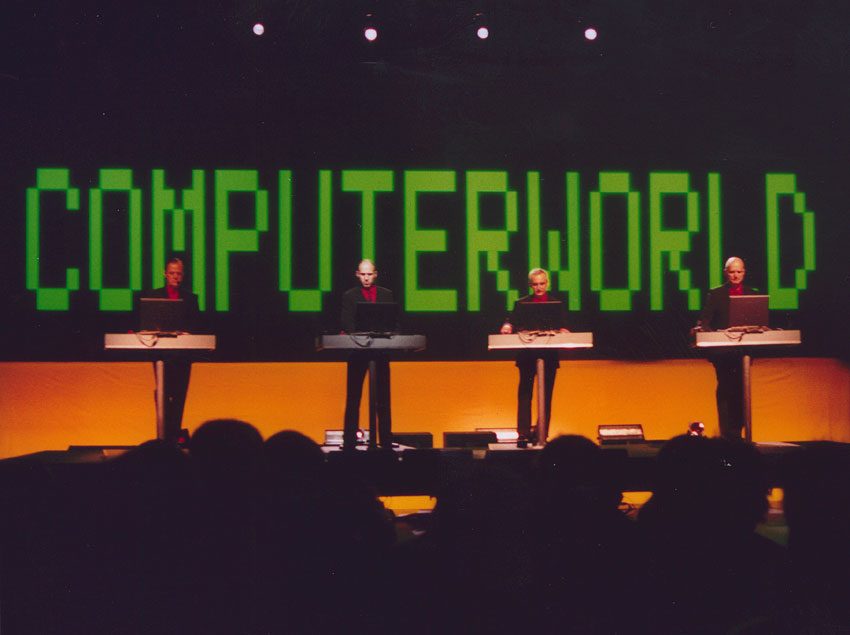
The Functional Beauty of Minimal Rhythm on “Pocket Calculator”
A buoyant track incorporating the bleeps of a handheld calculator and early speech synthesis. Mechanical yet unmistakably endearing, it sparkles with human humor and pop sensibility.
Built by sampling the chirping electronic tones of Japanese pocket calculators and miniature keyboards and placing them across an immaculate rhythmic grid, the song merges innocent curiosity about technology with German craftsmanship. The minimal electronic beats heard on “Computer World” and “Pocket Calculator” carry an irresistible pop bounce that moves the listener’s body despite their machine-made surface. By performing the idea of palm-sized technology changing the world as if playing with musical toys, Kraftwerk brought functional beauty and charm into the same frame.
The Future Envisioned by Ralf and Florian in Düsseldorf
Assembled with precision inside Kraftwerk’s private Kling Klang studio, this sonic world moved beyond the experimental spirit of Krautrock to complete the blueprint for global electropop.
Working without outside producers or engineers, building and modifying their own electronic instruments, and stripping away every trace of excess, Kraftwerk established the prototype for modern DIY electronic musicians. Kling Klang Studio in Düsseldorf operated as a strictly guarded sanctuary of electronics where every individual note was etched with their stoic aesthetic. The resulting sound—a crystallization of custom hardware and artisanal discipline—broadcast from Düsseldorf to the world and permanently altered the course of music history.
The Origin of Electronic Beats Passed Down to Hip-Hop and Techno
As Afrika Bambaataa famously demonstrated by sampling Kraftwerk on “Planet Rock,” their beats entered the bloodstream of dance music around the globe.
Echoing through the South Bronx in New York, Kraftwerk’s rhythms helped propel the birth of hip-hop and later provided decisive inspiration for the founders of Detroit techno, including Derrick May and Juan Atkins. The process by which German experimental electronics fused with American street culture and Black music to generate a new dance culture remains one of the most thrilling chapters in popular music history. Across continents, dancefloors found their foundational pulse in these rhythms.
Precision Sound Design Forged by Kling Klang Studio Craftsmanship
Inside their custom-built Kling Klang studio in Düsseldorf, Kraftwerk eliminated extraneous noise and sculpted pure analog synthesizer waveforms with an exactitude worthy of sonic alchemy.
Their custom vocoders and sequencers breathed lifelike expression into mechanical sound. Approaching technology not with fear, but as a medium to be mastered as art, gave their work its unmistakable poise. Purifying each grain of sound to the limit, the mix retains such clarity that even on modern high-resolution playback systems it never sounds dated, with every note sitting in its exact place.
A Prophetic Concept That Shines Even Brighter in the Digital Age
In an era when social media and artificial intelligence permeate daily life, the message of Computer World resonates with uncanny realism across business, finance, telecommunications, and private life alike.
Yet the future Kraftwerk sketched is threaded with wistful, aching melody. Listening closely today reveals an electronic flower blooming at the intersection of technology and humanity. Through the deliberate repetition of crisp electronic tones, they paradoxically threw into relief the human warmth and emotion we cannot afford to lose inside a mechanized world, leaving behind a nostalgic vision of the future that doubles as a quiet prescription for our digital present.
Conclusion: The Supreme Beauty of Synthesizers Playing the Future
Hard as it is to believe this record was made more than forty-five years ago, its forward-looking vision and nostalgic warmth remain inseparable.
An essential milestone in the history of electronic music, Computer World invites listeners to savor the contrast between precisely programmed synthesizer sequences and melancholy melodic lines. Where electronic music traveled from here can be heard in Aphex Twin’s Selected Ambient Works 85-92, while the branch that dissolved into environmental space appears in Brian Eno’s Apollo. And at the weathered far end of that lineage sits Aphex Twin’s Selected Ambient Works Volume II.